The SaaS marketing funnel is being replaced by agentic GTM systems.
- For most SaaS companies, the funnel is still the core operating model. It’s clean. Trackable. Familiar. And increasingly disconnected from reality.
- Stripe, HubSpot and Snowflake already operate beyond the funnel — signal-driven engagement, product-qualified leads, usage-based expansion.
- Outcome: SaaS companies adopting agentic GTM operate faster, more efficiently and more effectively than competitors still relying on static funnels.
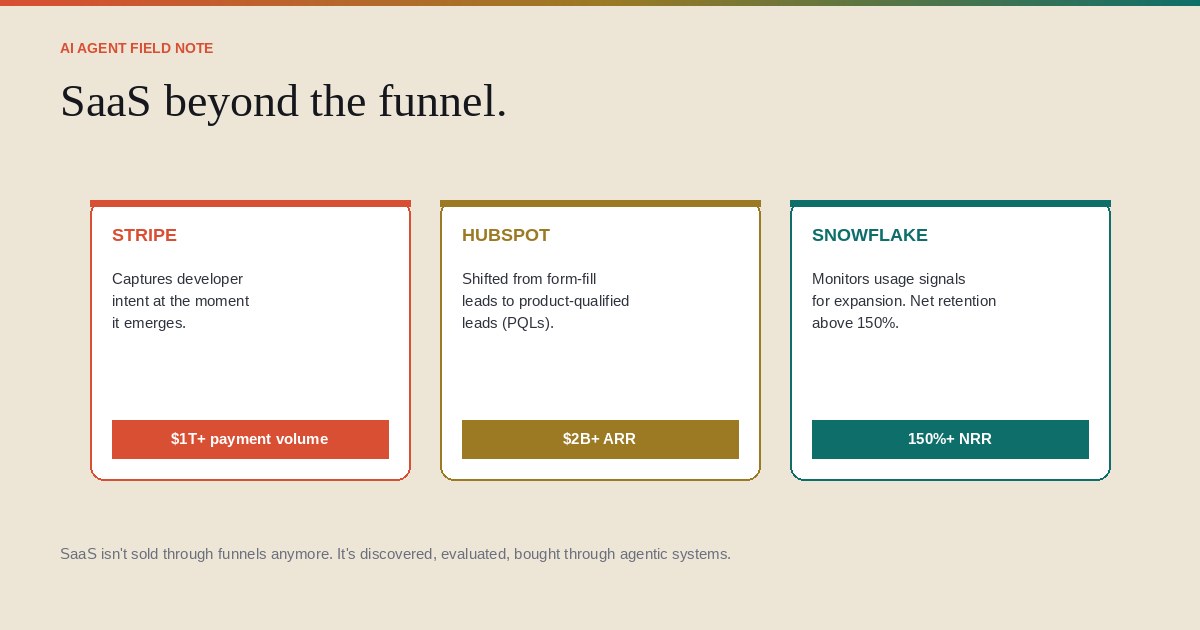
Stripe, HubSpot, Snowflake — three SaaS leaders that already operate beyond the funnel.
This piece is a SaaS-specific sector observation. The funnel still dominates SaaS GTM operating models — traffic, leads, MQLs, SQLs, opportunities, closed-won. Clean, trackable, familiar. And increasingly disconnected from reality.
The SaaS buying journey is mostly invisible to your funnel.
According to Gartner, B2B buyers spend only 17% of their buying time meeting with vendors. The rest happens independently. For SaaS companies, that means most evaluation happens across ChatGPT and Perplexity queries, G2 and Capterra reviews, Slack communities and peer networks, private internal discussions, and anonymous website visits. By the time someone fills out a demo form, the decision is often largely made.
Your funnel isn’t creating demand. It’s capturing demand that already exists. Conversion rates from cold traffic remain low — typically 1–3% for SaaS demo requests. Funnels are reactive systems. Modern SaaS markets reward proactive systems.
SaaS leaders already operate beyond the funnel.
Stripe — capturing developers when intent emerges
Stripe’s growth wasn’t driven by nurture campaigns. It was driven by presence at the exact moment developers needed payments infrastructure. Their documentation, APIs and ecosystem ensured that when intent emerged, Stripe was immediately adoptable. Today, Stripe processes over $1 trillion in payment volume annually — not because of funnels, but because of timing and accessibility.
HubSpot — shifting from lead funnels to product signals
HubSpot originally built its growth around inbound funnels. But over time, they shifted heavily toward product-qualified leads (PQLs). Why? Because users actively using the product signal intent far more reliably than form fills. HubSpot scaled to over $2 billion in ARR by prioritising behavioural signals over funnel stages.
Snowflake — using usage signals to drive expansion
Snowflake monitors product usage patterns continuously. When usage patterns indicate expansion opportunity, sales engages. This contributed to Snowflake achieving 150%+ net revenue retention, one of the highest in SaaS.
The fundamental shift: from funnel stages to intent signals.
Traditional funnels rely on artificial stages: MQL, SQL, Opportunity. Agentic GTM systems rely on real signals: multiple visits from the same account, pricing page engagement, hiring relevant roles, product trial usage, integration activity, AI assistant queries mentioning your category. These signals reveal intent far more accurately than funnel stages, because they reflect actual buyer behaviour rather than arbitrary classifications.
What agentic GTM looks like inside a SaaS company.
1. Continuous signal detection
Agentic systems monitor signals such as website visits from target accounts, product usage patterns, hiring activity, technology adoption, content engagement, and AI search and discovery patterns. Instead of waiting for leads, systems identify opportunities proactively.
2. Intent evaluation
Not every signal matters equally. Agentic systems evaluate signal frequency, recency, combinations and account fit. This produces dynamic intent scoring — more accurate than traditional lead scoring models.
3. Autonomous engagement
Once intent reaches a threshold, systems act immediately. According to Harvard Business Review, responding to leads within 5 minutes increases connection rates by up to 100× compared to slower responses. Agentic systems respond instantly.
4. Continuous optimisation
Agentic systems learn from outcomes. They refine which signals matter most, which accounts convert, which engagement strategies work. This creates compounding performance improvements.
The replacement for the funnel isn’t a better funnel. It’s an intelligent, always-on GTM system — humans define positioning, messaging, target markets and strategy; agentic systems execute signal detection, opportunity identification, engagement initiation and continuous optimisation.
The rise of AI buyers makes funnels even less relevant.
Increasingly, SaaS vendor discovery begins in AI systems. Buyers ask: “What’s the best CRM for startups?”, “Best ERP for manufacturing companies?”, “Alternatives to Salesforce?” AI systems recommend vendors. If your company isn’t understood and surfaced by AI systems, you’re excluded before the funnel begins. This shifts the GTM battleground upstream — from funnel conversion to AI discoverability.
What SaaS companies must do now.
SaaS leaders must shift focus from funnel optimisation to system optimisation. Key priorities include:
- Building strong presence across AI-discoverable channels
- Monitoring real buying signals, not form fills
- Responding to intent immediately
- Prioritising behavioural signals over static lead stages
- Designing GTM systems, not just campaigns
This isn’t a tooling change. It’s an operating model change. Funnels will continue to exist — but they’ll become secondary infrastructure. The primary system will be agentic, always-on, signal-driven and adaptive. The SaaS companies that adopt this model early will operate faster, more efficiently and more effectively than competitors still relying on static funnels.
Ready to operate beyond the funnel?
If you’re a SaaS leader thinking about signal-driven GTM, product-qualified leads, AI-discoverable presence, or autonomous engagement — we’ll walk through which two or three shifts would compound for your operating model, and what it takes to ship them. No deck, no pitch.
Get every field note in your inbox.
Industry-tailored briefings on AI agents, written for revenue leaders. One short note a week. No spam, unsubscribe in one click.
We’ll just ask for your name and company on the next step.