How we built an AI-powered marketing team in 14 days at IndustryGeniuses.
- Two weeks ago we asked: what if we built the entire marketing team around AI from day one? No big team, no long hiring cycles — just systems, prompts and execution.
- We mapped the marketing workflow, designed an AI org chart with ten specialist roles, built a prompt library, locked the brand voice, and shipped a content engine all inside 14 days.
- Outcome: one operator now produces the output of an entire marketing team — moving roughly 10× faster, with strategy and storytelling staying human.
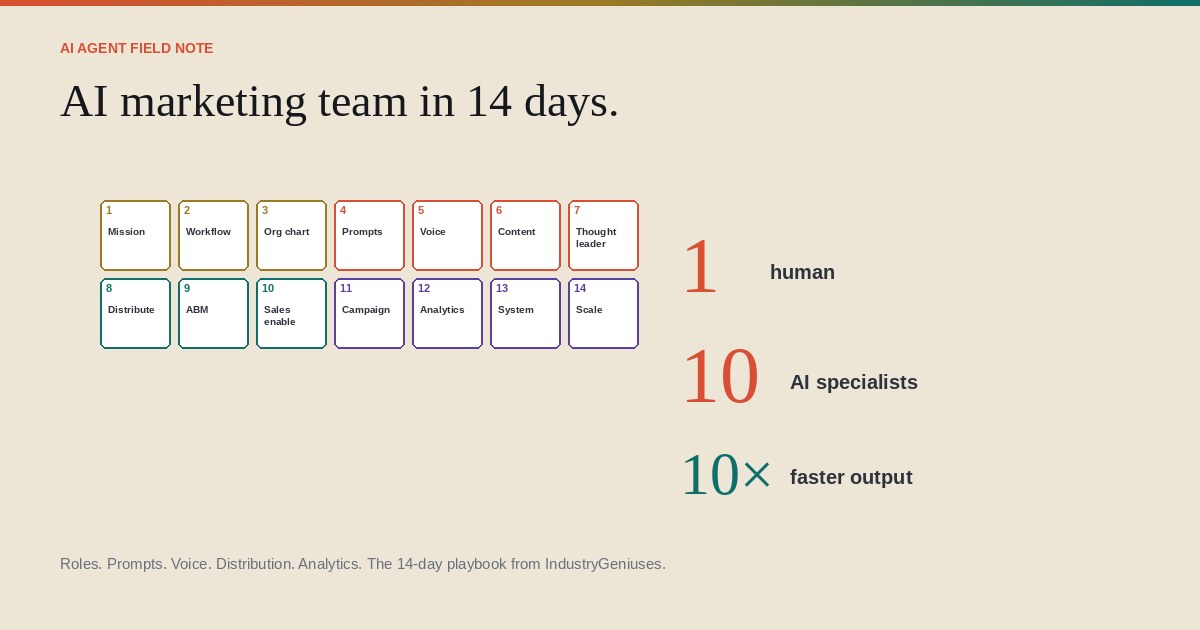
14 days. One human. Ten AI specialists. The marketing system at IndustryGeniuses.
This is a sector observation rather than an operator briefing — one of our occasional “from the field” pieces. Two weeks ago we asked a simple question: what if we built our entire marketing team around AI from day one? No big team, no long hiring cycles. Just systems, prompts and execution. Here’s the day-by-day record of how we did it.
Day 1 — Define the mission.
Before touching AI tools we defined the objective: generate authority in the AI space, publish high-value content consistently, support sales conversations, build audience and inbound pipeline. AI wasn’t the strategy. It was the engine.
Day 2 — Map the workflow.
Instead of thinking about roles, we mapped the work. The workflow looked like this: Research → Strategy → Content → Distribution → Conversion → Analysis. Every marketing team does these things. The difference is who does them.
Day 3 — Design the AI org chart.
Then we built an AI marketing org chart. Instead of people, we created AI roles:
- Market Research Analyst
- Content Strategist
- SEO Specialist
- Copywriter
- Campaign Architect
- Social Media Manager
- ABM Personalisation Agent
- Sales Enablement Writer
- Marketing Analyst
- Thought Leadership Ghostwriter
One human. Ten AI specialists.
Day 4 — Build the prompt library.
The real power isn’t the tool. It’s the prompts. We created reusable prompts for market analysis, blog creation, campaign planning, LinkedIn posts, sales collateral, ABM outreach. These prompts became our marketing playbooks. When you have a tuned prompt for “turn this customer call into a LinkedIn post in our voice,” you have an asset that compounds.
Day 5 — Lock the brand voice.
AI is powerful. But without guidance it sounds generic. So we created a brand voice guide: tone, messaging pillars, positioning, example posts, topics we care about. The brand voice document is the single most important reference we built in the entire 14 days.
Day 6 — Build the content engine.
Next we built a simple system: research topics, create pillar content, break it into smaller pieces, distribute everywhere. One article becomes ten LinkedIn posts, multiple short insights, newsletter content and sales material.
Day 7 — Launch thought leadership.
We focused on expert insight, not generic marketing. AI helps structure ideas. But the point of view stays human. Pure AI-generated content reads like AI-generated content. Human-led, AI-assisted thought leadership reads like a senior practitioner sharing what they think — because that’s what it is.
Day 8 — Build the distribution machine.
Most teams fail here. Content without distribution is invisible. So every asset gets: LinkedIn posts, community sharing, repurposed content, sales enablement snippets.
Day 9 — Add ABM personalisation.
AI made account-based marketing dramatically easier. For every target company we can generate tailored outreach, industry insights, personalised messaging and conversation starters. At scale.
Day 10 — Create sales enablement.
Marketing started feeding sales directly. We generated battlecards, objection responses, industry talking points and insight briefs.
Day 11 — Build the campaign engine.
We asked AI to design full campaigns: themes, messaging pillars, content assets, email sequences, social posts. Campaign planning that used to take weeks now takes hours.
Day 12 — Add analytics and feedback.
AI also reviews performance. We analyse engagement, content performance, audience interests, experiment ideas. This creates a continuous improvement loop.
Day 13 — Turn it into a system.
By this point we didn’t have a marketing team. We had a marketing system: prompts, templates, workflows, distribution loops, all running through AI.
Day 14 — Scale the output.
The result: one person can now produce the output of an entire marketing team. More importantly, we move roughly 10× faster.
AI doesn’t replace marketing. It replaces the mechanical work of marketing — freeing humans to focus on strategy, ideas, positioning and storytelling.
What this would look like for your organisation.
The 14-day marketing-system build is a fit for almost any B2B firm where the team is small relative to the marketing ambition, the product is technical enough that off-the-shelf AI content reads as wrong, and there’s one strong senior operator who can supervise the system. The decision being asked of a CMO or founder isn’t “should we use AI in marketing?” — it’s “am I willing to invest two weeks of senior operator time into a system that compounds?”
Want to build your own AI marketing system?
If you’re considering an AI-first marketing build — ten specialist agents, a tuned prompt library, a brand-voice document, a content engine that compounds — we’ll walk through what your 14-day version would look like, what your senior operator would own, and where the editorial discipline matters most. No deck, no pitch.
Get every field note in your inbox.
Industry-tailored briefings on AI agents, written for revenue leaders. One short note a week. No spam, unsubscribe in one click.
We’ll just ask for your name and company on the next step.