How a UK national charity raised 10× from a single giving month.
- A UK-wide cause-marketing programme needed payroll managers and HR leads at FTSE 250 firms to act inside one campaign month.
- We deployed three AI agents alongside the in-house team for ten weeks — Donor Engagement, Event Follow-Up, Reporting.
- Outcome: 10× return on campaign spend, with corporate-partnership conversations carrying into the following quarter.
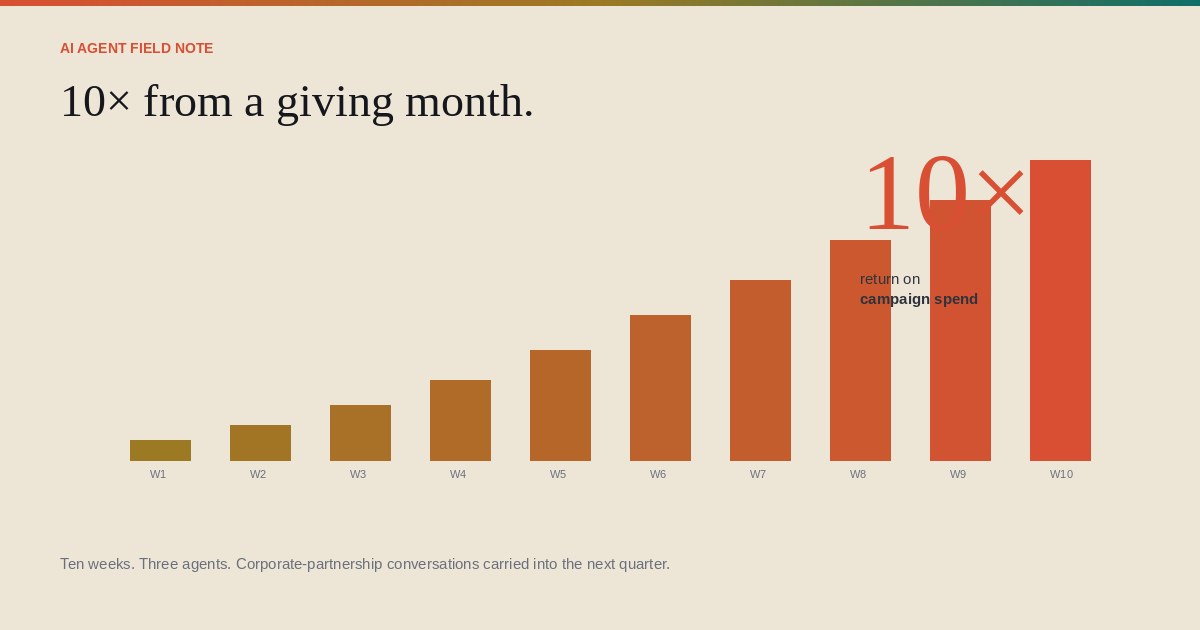
10× return on campaign spend across a 10-week giving month window.
This is the first in our AI Agent Field Notes series — industry-tailored briefings for revenue leaders thinking about deploying AI agents inside their own teams. Each piece draws from a live engagement, walks through what we put in, what changed, and what it took to keep running. We’ve anonymised the client and paraphrased the numbers to respect their preferences. Everything else is real.
The brief.
The organisation runs an annual national charity giving month — a campaign window where the UK’s largest employers are encouraged to roll out, expand or refresh their payroll giving programmes. The audience: payroll managers, finance directors and HR leads inside FTSE 250 employers. The asks: enrol new employees, renew lapsed agreements, secure CSR sponsorship from the corporate parent.
The challenge wasn’t awareness. It was compression. The campaign window is one month. Buyer attention inside corporate HR and payroll departments is competitive at the best of times; in the run-up to year-end it’s especially so. The team had run the campaign every year for five years with steady but unspectacular results — good awareness, modest enrolment lift, opaque attribution.
What they wanted from us was straightforward: more activity per pound, with cleaner reporting at the end. What they didn’t want was an agency-style retainer or a six-month strategy refresh. The campaign was already designed; the team needed amplification, not redirection.
The three agents we put in.
We deployed three AI agents alongside the in-house team. Each ran for ten weeks — two weeks of setup and pre-campaign warm-up, the four-week campaign window itself, then four weeks of follow-up and reporting close-out.
Donor Engagement Agent
Researched a named target list of payroll managers and HR leads at 220 FTSE 250 employers. Built a dossier for each — existing payroll-giving programme status, scheme provider used, last reported employee uptake, public CSR commitments, recent leadership changes. Drafted personalised outreach messages in three flavours: cold (no existing relationship), warm (lapsed or quiet relationship), live (active programme). Director-level review on every send.
Event Follow-Up Agent
The campaign included three corporate breakfast briefings in London, Birmingham and Manchester, and one national webinar. The agent ingested every guest list, every conversation note from the team, every webinar attendance and engagement record — usually within the same evening as each event. Drafted personalised follow-up to each attendee in the right team member’s voice, classified follow-up actions (decision-maker · referrer · enquirer · not-now), and routed the warm prospects directly into the development team’s diary.
Reporting Agent
Pulled numbers daily from the email tool, the events platform, the website analytics, the donor database and the LinkedIn ad accounts into one consolidated view. Tracked which campaign messages drove which engagement, which engagement led to which booked meeting, which meeting led to which corporate sign-up. Drafted a weekly summary for the trustees and a final cost-to-raise report at month-end — both in the format the CEO already used for board updates.
What changed.
Three numbers worth pulling out:
The 10× number is the headline, but the texture matters more. Three things changed about how the team operated week-to-week:
Outreach personalisation went from impossible to default. In previous years, the team had picked roughly thirty “tier-one” targets to write to personally and used a generic template for the rest. With the agent in place, all 220 named targets received outreach written specifically for their organisation, their existing programme status, and their relevant CSR or leadership context. The Director who normally spent two weeks drafting cold outreach instead spent that time reviewing and approving drafts.
Event follow-up moved from post-hoc to same-day. The London breakfast had 38 attendees. By the time the Manchester breakfast happened ten days later, 26 of those London attendees had already received personalised follow-up, eight had booked secondary conversations, and two had moved their organisation’s payroll-giving programme decision into Q4 review. In a normal campaign cycle, that London follow-up would still have been on the team’s to-do list when the Manchester event happened.
Reporting became a working tool, not a quarterly artefact. The trustees received a one-page Friday summary every week. By week three, the CEO was using it to reallocate the remaining ad spend in real time — pulling money from the lower-engaged channel and pushing it into the channel where outreach replies were converging on actual booked meetings. That kind of mid-campaign reallocation hadn’t been possible in previous years because the data was always stale.
The agents didn’t replace the team. They did the things the team had always wanted to do but never had time for: personalise everything, follow up everyone, report continuously.
What it took to keep running.
This is the part most case studies skip. Worth being honest about it because it’s the part that determines whether a deployment actually delivers.
1. A senior person on the customer side, two-to-three hours a week.
The Director of Fundraising spent ninety minutes most Mondays reviewing and approving draft outreach, plus a thirty-minute Friday call walking through the weekly report. Without that review cadence, the agent’s outreach quality would have drifted within two weeks. Agents are excellent at scale and consistency; senior judgement is still what makes the difference between “technically personalised” and “a message a busy CFO will actually reply to.”
2. A clear escalation path for the awkward conversations.
About one in twelve outreach replies needed a human to step in immediately — a sensitive question about an organisational change, a request for a bespoke arrangement, a reply from a name the team hadn’t expected to hear from. We routed those into a shared Slack channel where two senior people watched in real time. Without that routing, the speed advantage of same-day follow-up would have been wasted on the highest-value replies.
3. Tolerance for a few visible mistakes early on.
In week two, the agent referred to one programme officer’s previous employer instead of their current one. The Director caught it before send. The team adjusted the agent’s research source-priority and that class of error didn’t reappear. But it did happen, and it would have happened in any deployment we’ve run. Anyone telling you AI agents work flawlessly out of the box has not actually run AI agents in production.
Would we do it again?
Yes — with three changes worth flagging for any organisation considering this kind of programme.
Start the agents earlier. Two weeks of pre-campaign warm-up worked, but four would have been better. The first week was effectively spent calibrating the Donor Engagement Agent’s tone-of-voice and source-priority. If we’d had four weeks, the campaign window itself would have run smoother from day one.
Add a Signal Agent next time. We didn’t deploy one in this engagement. With hindsight, watching live signals on the target list — new HR leadership, restructuring announcements, CSR strategy refreshes — would have surfaced four or five high-value targets we missed in the initial research pass.
Build the post-campaign motion before the campaign. The 10× return is real, but it includes corporate-partnership conversations that started during the campaign month and converted in the following quarter. We had to build the warm-prospect handover process during the final two weeks of the engagement, partly under time pressure. Better to have agreed it during setup.
What this would look like for your organisation.
The same three-agent stack — Donor Engagement, Event Follow-Up, Reporting — works for many of the time-bound campaigns inside non-profit and adjacent sectors:
- A national charity month or week (cancer, mental health, hunger, environment)
- A university development cycle — alumni giving, capital appeals, named-fund cultivation
- A hospital charity capital appeal or major-gift campaign
- A cultural-sector membership drive (museums, arts organisations, professional societies)
- A faith-based community’s annual giving cycle or capital programme
It also adapts cleanly into commercial settings — the same Donor Engagement Agent becomes an Account Engagement Agent for a B2B sales team running a quarterly campaign window; the Event Follow-Up Agent works identically whether the event is a fundraising breakfast or a customer conference; the Reporting Agent does the same job on either side of the for-profit / non-profit line.
The decision a revenue leader is being asked to make isn’t “should we do AI?” — that’s the wrong frame. The decision is “is there a campaign window in the next six months where time-compression is the real constraint, and would we rather solve it with another five hires or with three agents and one director’s time?”
Want to talk about your next campaign?
If you’ve got a window or campaign coming up — a product launch, a customer event, a quarterly push, a market entry — we’ll walk through which two or three agents would move the needle, what we’d build, and what your team would need to do to make it work. No deck, no pitch.
Get every field note in your inbox.
Industry-tailored briefings on AI agents, written for revenue leaders. One short note a week. No spam, unsubscribe in one click.
We’ll just ask for your name and company on the next step.