A cloud-banking vendor hit 150% of registration target for a UKI banking-leader programme.
- A US-headquartered cloud-banking software vendor wanted senior banking executives in the UK and Ireland in one room for a peer-to-peer programme — and wanted them registered, attending and following through on the conversation.
- We deployed three AI agents alongside the in-house demand-gen and field-marketing teams — Account Engagement, Event Follow-Up, Pipeline Hygiene.
- Outcome: 150% of registration target, with the post-event pipeline cleaner and more sequence-able than any prior banking-leader event the team had run.
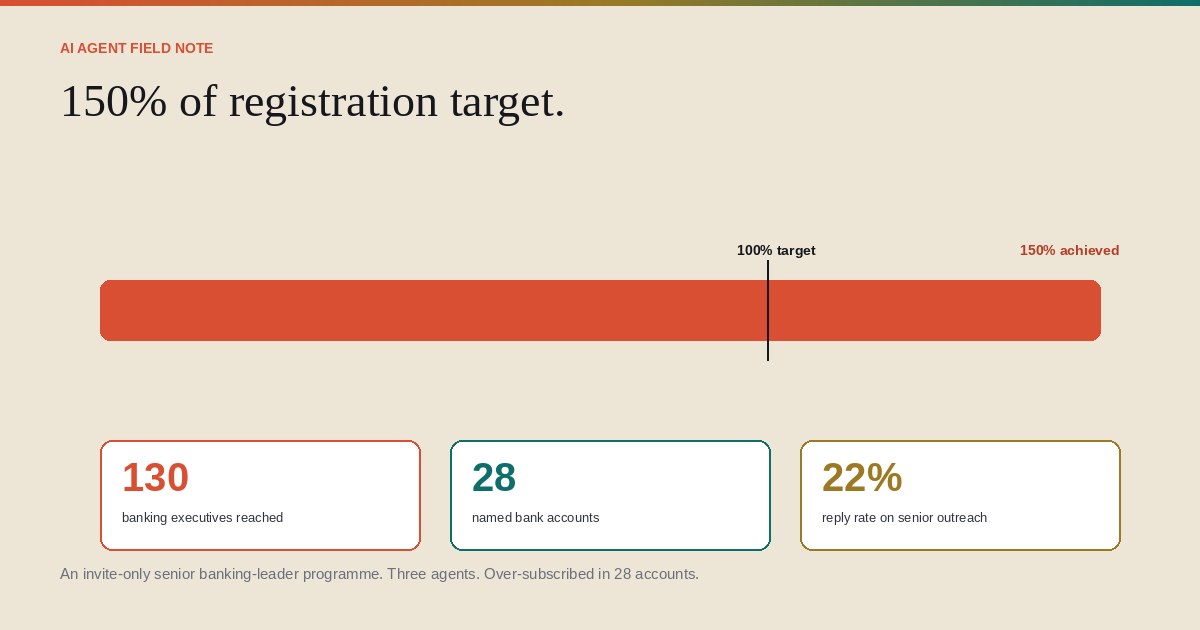
150% of senior-attendee target. The numbers behind a peer-to-peer programme.
Third in our AI Agent Field Notes series. This one’s about events — specifically, the kind of senior-buyer programme where registration is the easy bit and turning attendance into pipeline is the hard bit. Anonymised client, paraphrased numbers.
The brief.
The vendor sells cloud-native software into banks — commercial lending, treasury management, onboarding, the operational core. UK and Ireland was a strategic market for them: most of the relevant retail and challenger banks were on a public modernisation track, and the field team had built relationships with most of them over four years. What they didn’t have was a regular cadence for getting heads-of-function (CTOs, COOs, Heads of Lending, Heads of Operations) into the same room together for a real conversation about modernisation strategy.
The brief was to design and run a banking-leader programme — an invite-only, peer-to-peer format, no slide-ware, lunch and dinner around it. Target: 40 confirmed senior attendees. Budget: meaningful but not unlimited. Constraint: most of these executives wouldn’t respond to a generic invite from a vendor, and the in-house field team was already at capacity running named-account work.
The risk: invite-only programmes that under-fill are worse than not running at all. A half-empty boardroom in front of 12 senior bank executives is not a recoverable position. The number we had to hit wasn’t “enough sign-ups” — it was “the right people, confirmed in advance, who would actually walk through the door.”
The three agents we put in.
This is an event programme, but two of the three agents had to do work well before the event existed. Building the right invite list, warming up the right relationships, and keeping the data clean across the multi-channel motion are all weeks of work that compound.
Account Engagement Agent
Built a target list of 130 named UKI banking executives across 28 named bank accounts. Researched each — current modernisation programme status, public commitments at industry events, recent strategic initiatives, peer relationships. Drafted invitation outreach in three flavours: from the field rep with existing relationship, from the regional VP for accounts with no field rep coverage, and a peer-validation track where existing customer-CIOs were asked to extend invitations to their peer network. Field reps reviewed and approved every send.
Event Follow-Up Agent
Worked across both before-event and after-event motions. Pre-event: read every confirmation reply, dietary requirement, schedule clash, and travel question; routed bespoke responses to field reps within hours. Post-event: ingested every conversation note from the dinner and the daytime sessions, drafted personalised follow-up to each attendee in the relevant field rep’s voice, classified follow-up actions (hot — needs decision-maker conversation in next 14 days · warm — specific opportunity to develop · referral — engaged but for a colleague · cold — relationship-building only).
Pipeline Hygiene Agent
Cleaned and stewarded the 130-person target list as the programme evolved. Deduplicated against the existing CRM, enriched missing seniority and reporting-line data, scored each contact against the ideal-attendee profile, and tracked the full status of each invitation across email, LinkedIn and phone. The agent kept the master view current to the day — so when the regional VP wanted to know “who’s confirmed, who’s soft, who’s a maybe, who’s declined,” she got the answer in one screen rather than waiting on a marketing-ops run.
What changed.
The 150% headline is the event marketing number. Three things changed about how the team ran the programme:
Personalisation went from theatre to default. Most enterprise event invites — even the “personalised” ones — vary three lines of cold copy across a list of 200 names. The Account Engagement Agent let the field team do the real version: every invitation referenced the recipient’s actual current programme, public commitments, and what their peers were doing. The reply rate from senior banking executives went from 6–8% on prior generic invitations to 22% on this programme. That difference is the difference between half-empty and over-subscribed.
The pre-event motion stopped leaking warm prospects. Banking executives say yes, then their PA reschedules, then a board meeting moves, then a flight cancels. In a normal programme, half a dozen of those reschedules end with the prospect dropping off the list because nobody noticed in time to recover them. The Event Follow-Up Agent caught all the schedule churn in real time and fed it into a working list the field team could actively manage. We recovered five attendees who would have silently dropped in a normal programme.
Post-event follow-up went from bottlenecked to in-flight by Monday. The event was a Thursday-Friday. By the following Monday, every attendee had personalised follow-up landed in their inbox in the right field rep’s voice, with the right next-step ask. The previous banking-leader programme had follow-up still in draft three weeks later because the field team was already absorbed back into other work. By the time those follow-ups went out, the conversations had cooled.
An invite-only senior programme is mostly won or lost in the boring weeks before and after. Agents are extremely good at the boring weeks.
What it took to keep running.
1. Field rep ownership of every approval.
Every outbound from a field rep’s account was reviewed and approved by that rep before sending. Non-negotiable for senior banking outreach — a CTO will spot an off-tone message immediately and will hold it against the vendor for years. Average review burden across the field team: about thirty minutes a week per rep. That trade is excellent. The alternative is the rep doing the research, drafting and sending themselves, which is multiple hours a week per account.
2. The field marketer had to act as agent operator.
One person in the field marketing team became the day-to-day operator of the agents — tuning prompts, handling exceptions, escalating ambiguous cases. About a day and a half a week of that person’s time. Without a designated operator, the agents drift. With one, they compound week-on-week. This is the role most companies under-resource when they first deploy AI agents.
3. We had to be honest about what the agents couldn’t do.
The Pipeline Hygiene Agent kept the data clean but it couldn’t adjudicate the political question of which field rep “owned” a given executive. Two cases came up where two reps both had a relationship with the same banking executive and had been independently working the relationship. The agent surfaced the conflict; the regional VP had to resolve it. Agents are excellent at surfacing the questions that need senior judgement; they are not the right place for the senior judgement itself.
Would we do it again?
Yes — and the team has, twice. Three changes we made for subsequent programmes:
Run a Signal Agent in parallel. The first programme we did without one. The next two had one watching for executive transitions, restructuring announcements, and competitor wins across the target list — and that fed the invite-list refresh process for the next programme months in advance.
Build the post-event nurture motion before the invite goes out. The first programme’s follow-up was excellent for two weeks and patchy thereafter, because we hadn’t agreed in advance who owned the warm conversations after week three. Now we have that conversation before invitations send.
Re-use the dossiers. The Account Engagement Agent built 130 detailed executive dossiers for this programme. Six months later, those dossiers were still useful — refreshed by the agent for any signal-driven changes — and reduced the lead time for the next programme by weeks.
What this would look like for your organisation.
The same three-agent stack works for many invite-only senior-buyer formats:
- Banking and insurance executive briefings — CTO, COO, Head-of-function programmes
- Healthcare CIO and digital-transformation executive forums
- Retail and consumer leadership dinners and category-strategy roundtables
- Public-sector senior-buyer briefings (where the same care about personalisation matters even more)
- Channel-partner senior advisory boards
The decision being asked of a CMO or VP Demand-Gen here isn’t “should we do an event?” — the strategic case for senior-buyer programmes is well-understood. The decision is “can we run this with the rigour senior buyers expect, without burning out the field marketing team between Q1 and Q4?” Three agents and a designated operator make that possible.
Planning a senior-buyer programme this quarter?
If you’ve got an executive briefing, an analyst day, an invite-only dinner or a banking-leader format coming up — we’ll walk through which agents would do the work, what your field team would still own, and how to make sure the post-event motion doesn’t go cold. No deck, no pitch.
Get every field note in your inbox.
Industry-tailored briefings on AI agents, written for revenue leaders. One short note a week. No spam, unsubscribe in one click.
We’ll just ask for your name and company on the next step.