Cold-starting a UK lending platform in the US in 30 days.
- A UK lending platform — established in their UK home market — needed to test US market viability before committing to a permanent US team. The window: 30 days, with the goal of qualified opportunities in pipeline.
- We deployed three AI agents alongside a UK-based founder — Signal, Account Engagement, Event Follow-Up.
- Outcome: 30 days to first qualified US opportunities, with enough pattern-shape across the pipeline to make the “permanent US presence yes/no” decision with confidence.
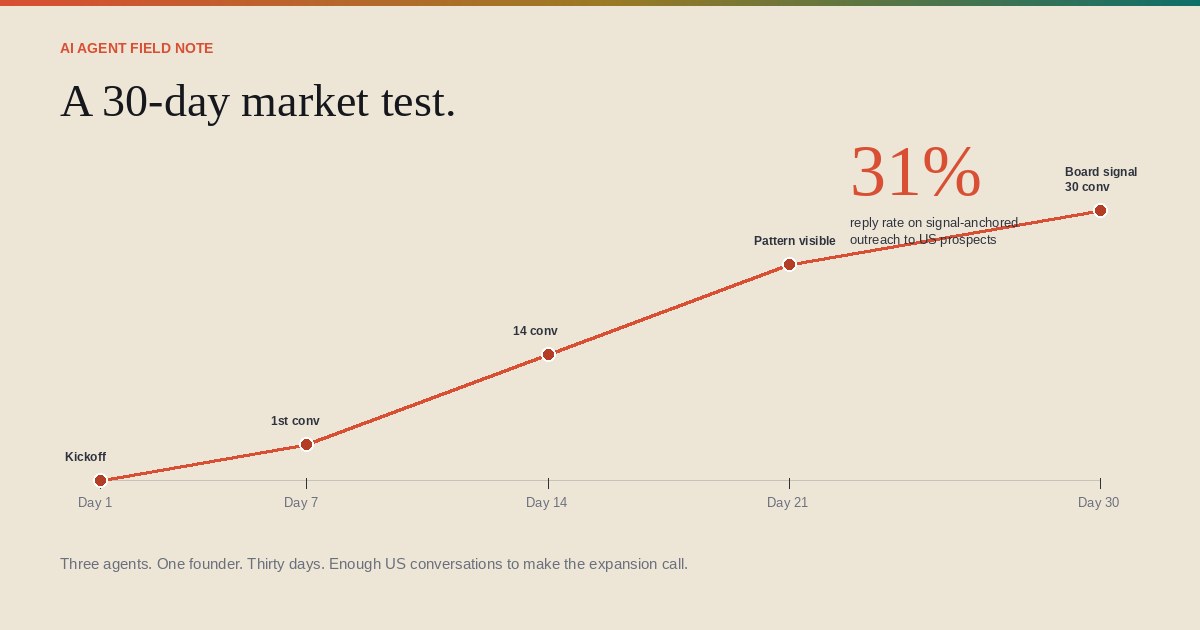
30 days, 30 conversations, one founder. The trajectory that built board confidence.
Fifth and final piece in the launch cohort of AI Agent Field Notes. This one’s the shortest sprint we’ve covered — thirty days, no US headcount, signal-led from day one. Anonymised client, paraphrased numbers.
The brief.
The company is a UK lending platform — established and growing in the UK SME and mid-market lending space, with a clear product-market fit at home and a board that wanted to know whether the US was worth a real investment. They were not, at this point, expanding to the US. They were testing whether expansion was the right next step.
The brief was deliberately bounded. Thirty days, no US-based hires, no opening of a US legal entity yet, no PR push. What the founder wanted was qualitative and quantitative signal: would US lenders, treasurers and fintech buyers respond? If they responded, how did the conversation differ from UK conversations? Was the value proposition translating, or did the US version of this market expect something different?
The risk in this kind of test is well known: thirty days isn’t long enough to build a network from scratch, and any “US test” that produces three meetings is statistically meaningless. We needed enough conversation volume to detect signal, fast enough to fit the window, with enough quality that the founder’s thirty-minute calls would be with real prospects rather than tyre-kickers.
The three agents we put in.
This engagement leaned harder on the Signal Agent than any of the others in this launch cohort. With no existing US relationships and no time to build them organically, signal-driven outreach was the only viable way to get to qualified conversations inside thirty days.
Signal Agent
Watched the US lending and fintech landscape for buying-window signals: regional banks announcing SME-lending modernisation, credit unions publishing technology-vendor RFPs, fintechs hiring new VP Lending or Head of Underwriting, fintech-bank partnership announcements, public commentary on lending-tech pain points from named US executives. About 60–90 signals a week, scored against the company’s ICP, with the top dozen surfaced to the founder each Monday morning. Two of the four most-advanced US conversations came directly from week-one signals.
Account Engagement Agent
Built dossiers on the prioritised signals and drafted personalised outreach in the founder’s voice. Each piece of outreach was anchored to the specific signal that triggered it — not a generic “we’re a UK lending platform exploring the US” but a precise “noticed your firm published an RFP for SME underwriting modernisation last week; here’s how we’d think about that problem from a UK perspective, with three lessons we learned the hard way.” The founder reviewed every send. Reply rate on signal-anchored outreach: 31% over the thirty-day window.
Event Follow-Up Agent
The founder didn’t run any US events in this window — that was a deliberate constraint. But he did three industry-podcast appearances and two virtual webinar guest spots aimed at US audiences, and the agent treated those exactly the way it would treat in-person events. Ingested the listener questions, the chat-channel conversations, the LinkedIn engagement on the appearance posts. Drafted personalised outreach to anyone who’d engaged meaningfully. Two of the four most-advanced US conversations came from podcast listeners who’d engaged in week one and been followed up the same week.
What changed.
The thirty-day window is the headline; the real value was qualitative. Three things became visible by the end of the window:
The US version of this market behaves differently — and the founder learned exactly how, by talking to the right people. Going in, the assumption was that the US market would look like a 5× bigger version of the UK market. By week three it was clear that the US lending-tech buyer thinks about regulatory perimeter, integration depth and credit-union association dynamics in ways UK buyers don’t. The founder ended the thirty days with a sharper version of the value proposition than he’d started with — not because the agents told him so, but because the agents let him have thirty serious conversations with the right buyers in a window where he’d normally have had three.
Signal-anchored outreach outperformed every other channel by a wide margin. The 31% reply rate was high because every piece of outreach referenced something the recipient had publicly committed to or announced in the past 14 days. The agent surfaced the signal; the founder approved the response; the buyer felt understood rather than spammed. This pattern shows up in every signal-led engagement we’ve run, but the magnitude is sharper in cold-start expansion than in warm relationship work.
The thirty-day output was enough to make the board decision with confidence. That’s really the point. The board didn’t ask “did you generate $X of US pipeline?” — they asked “do you have enough signal to commit to a US presence, or enough to walk away with conviction?” The four advanced conversations, plus the two dozen lighter ones, plus the qualitative pattern-recognition the founder did across all of them, was sufficient evidence to greenlight a permanent US team-of-three for the following quarter.
The right way to test a new market isn’t to hire a sales rep and wait six months. It’s to have thirty serious conversations with the right buyers in thirty days — and use the pattern those conversations reveal to make the real expansion decision properly.
What it took to keep running.
1. The founder’s time, intensely, for one month.
Roughly three hours a day, every weekday, for thirty days. That’s a real ask — and the founder told us in week two that it was the most concentrated period of personal selling work he’d done in two years. Worth being honest: this kind of cold-start sprint isn’t something a CEO can do casually alongside their day job. It is, however, far less time than he’d have spent if the alternative was hiring and ramping a US salesperson over six months while himself flying back and forth.
2. A clear escalation rule for the “not yet” replies.
Roughly a third of replies were genuinely warm but not the right window — “your timing is off by a quarter, come back to me in May.” Without a clear nurture motion, those would have evaporated. We set up a long-running follow-up cadence for any reply that wasn’t an outright no, with the agents handling continued contextual touches every 4–6 weeks. Six months on, three of those “not yet” replies had converted into active opportunities.
3. We had to be careful about over-fitting to thirty days.
Thirty days is enough time to find the shape of a market, not the size of it. The founder had to resist the temptation to commit to or rule out major decisions purely on what the thirty-day window said. We talked about this explicitly in week three when the conversations started landing well: the question wasn’t “is this working” (it was), it was “is what we’re seeing representative of how the next twelve months would go.” A short test is excellent for sharpening conviction; it’s a poor substitute for sustained execution.
Would we do it again?
Yes — this kind of bounded, signal-led market test is now our default recommendation when a CEO is considering serious expansion. Three changes for next time:
Build the “not yet” nurture before the sprint starts. We bolted it on in week three. With hindsight, it should have been part of the kickoff design, because the “not yet” replies started arriving in week one and we lost a few days of nurture cadence on the earliest ones.
Add a Reporting Agent for the board readout. The founder synthesised the thirty days himself, on a long flight home, into a board paper. It worked because he’s good at that kind of synthesis, but a Reporting Agent could have produced the underlying pattern-recognition continuously through the window and saved him the flight.
Treat the post-sprint as part of the engagement, not a hand-off. The board approved the US expansion on the strength of the thirty-day evidence; the in-house team that took it forward had to rebuild momentum because the agents went quiet at day 31. Now we run a continuation phase by default — lighter touch, but enough to keep the warm conversations warm during the gap between board decision and team build.
What this would look like for your organisation.
The thirty-day market-test pattern works for almost any high-stakes expansion or pivot decision where the cost of getting it wrong is high and the cost of waiting six months for clarity is also high:
- UK fintechs testing the US market before committing to a permanent presence
- US-based firms testing the UK and EU market via a UK beachhead (the mirror version)
- SaaS firms testing whether their product translates to a new vertical (e.g. moving from tech-buyer ICPs to financial-services ICPs)
- An incumbent in one segment testing demand in an adjacent segment (e.g. enterprise lender testing mid-market or vice-versa)
- A founder considering a major repositioning, who wants buyer-feedback evidence before committing
The decision being asked of a CEO or founder here isn’t “should we expand?” — that’s a strategy question. The decision is “before we commit a year’s budget to the wrong answer, can we run thirty days of serious evidence-gathering with the right buyers, and let what we learn shape the expansion plan rather than guess at it from a deck?” Three agents and one founder’s month make that possible.
Considering an expansion or repositioning?
If you’ve got a market entry, vertical pivot or major repositioning decision in the next two quarters — we’ll walk through what a thirty-day signal-led test would cover, which agents we’d run, and what evidence you’d come out with. No deck, no pitch.
Get every field note in your inbox.
Industry-tailored briefings on AI agents, written for revenue leaders. One short note a week. No spam, unsubscribe in one click.
We’ll just ask for your name and company on the next step.