A UK food-tech challenger’s first 90 days expanding into North America.
- A UK B2B food-tech company — established in the UK, unknown in North America — needed pipeline in Canada within one quarter to anchor a planned US push.
- We deployed three AI agents alongside a senior commercial lead for 90 days — Account Engagement, Content Engine, Signal.
- Outcome: Canadian pipeline doubled in 90 days, with three named retailer conversations advanced enough to brief their UK leadership at quarter-end.
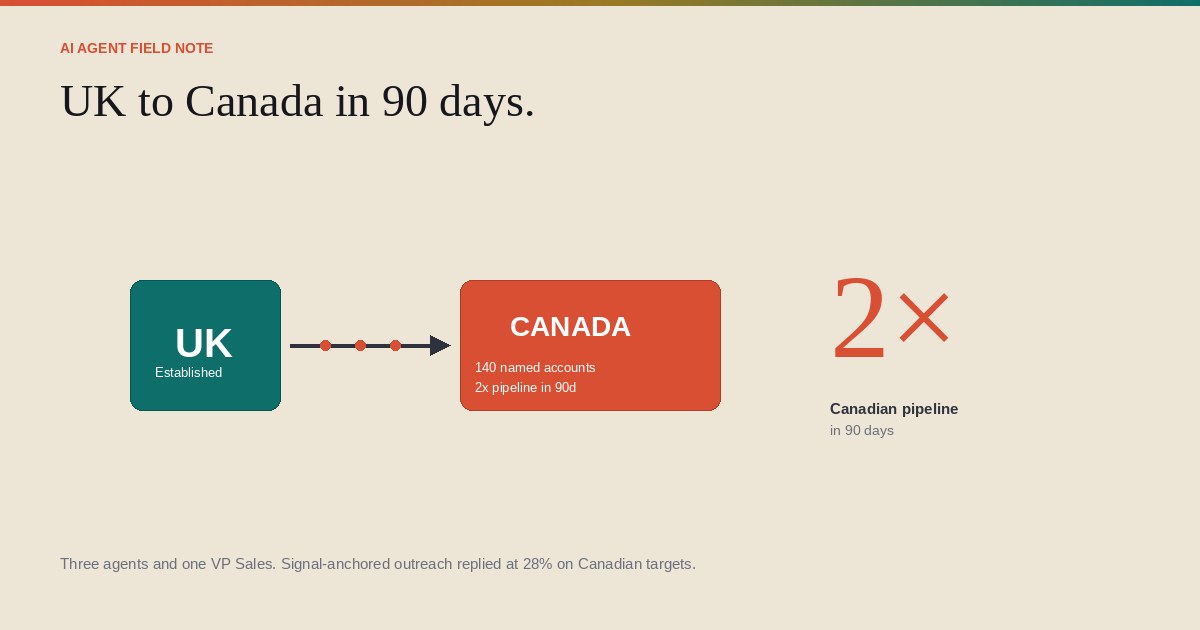
UK to Canada in 90 days. 140 named accounts and a 2× pipeline lift.
Second in our AI Agent Field Notes series. This one’s a market-entry story — same agents, very different brief from the charity giving month we covered last week. We’ve anonymised the client and paraphrased the numbers; everything else is real.
The brief.
The company is a UK B2B food-tech firm selling into grocery retailers, wholesalers and large hospitality groups. In the UK they’ve been a known quantity for several years — on the buyer panels at the major chains, embedded with two of the big four supermarkets. North America was a different story: zero brand recognition, no existing relationships, no analyst footprint, and a sales motion that needed at least one Canadian customer reference before they’d be taken seriously by a US prospect.
The constraint was time, not talent. Their commercial leadership was strong — an experienced VP Sales who had run UK retail accounts for a decade — but she was new to North America and didn’t have a pre-built network there. Hiring a Canadian rep and waiting six months for them to build pipeline was the obvious play, but the board wanted commercial proof inside one quarter to validate the next round of investment.
The brief: get to first qualified Canadian conversations within 90 days, with enough volume that pattern-detection becomes possible — not just one lucky meeting, but a pipeline shape they could read.
The three agents we put in.
Three agents, no Canadian rep yet. The VP Sales was the only human commercial resource on this engagement — everything else came from the agents working alongside her, with our team handling agent operations.
Account Engagement Agent
Built and qualified a target list of 140 named Canadian accounts: top-25 grocery chains, mid-market regional retailers across Ontario, Québec and BC, plus the major hospitality groups and food-service operators. Researched each — current category strategy, recent leadership moves, public technology partnerships, signs of UK market interest. Drafted personalised outreach to the right buyer at each — usually a Director of Category, Head of Innovation or VP Buying. The VP Sales reviewed and approved every send; the agent handled everything from research to draft.
Content Engine Agent
The company had three years of UK case studies but nothing positioned for a Canadian buyer. The agent rewrote ten of those case studies into Canadian-context briefings — same underlying outcomes, but with category benchmarks, regulatory references and language Canadian buyers actually use. Drafted two thought-leadership LinkedIn posts a week from the VP Sales’ account, plus a category-specific webinar deck and three one-page sales briefings. Everything voiced as her, reviewed weekly.
Signal Agent
Watched the 140 target accounts for buying signals — new VP Category appointments, RFP releases, public technology-partnership announcements, supply-chain restructurings, mentions in trade press. Surfaced 30–40 signals a week, scored each against the company’s ICP, and pinged the VP Sales on the dozen most actionable. Two of the three named retailer conversations that advanced furthest came directly from signals the agent caught in week four and week seven.
What changed.
The doubling number is the headline; the texture is more interesting. Three changes worth pulling out:
The VP Sales went from cold-starting to running a working motion in week three. Without the agents, she’d have spent the first six weeks researching the market, building lists, and writing outreach — which is what cold-start solo expansion looks like everywhere we see it. Instead, by end of week two she had 140 researched accounts ready, 30 of them already in active outreach, and a content rhythm starting to compound on LinkedIn. By week three, replies were coming back faster than her diary could absorb — which is the right kind of problem.
Signal-driven outreach outperformed cold outreach roughly four to one. The Account Engagement Agent’s cold outreach landed at a perfectly reasonable 6–8% reply rate. The same outreach, sent within 48 hours of a signal the agent caught, landed at 28%. That’s the multiplier you get when AI agents work in concert: the signal makes the cold outreach warm before it lands.
The content motion built market presence without market spend. The VP Sales went from 800 LinkedIn followers (mostly UK) to 3,400 (mix of UK and Canada) over the quarter. Three of the named accounts opened conversations citing her LinkedIn writing as the trigger. That’s a budget line they didn’t spend — no Canadian PR firm, no paid syndication, no event-circuit hires.
Solo cold-start expansion is the slowest, most expensive way to enter a market. Three agents and one experienced commercial lead can compress what normally takes six months and three hires into one quarter.
What it took to keep running.
1. The VP Sales had to write in public.
The Content Engine Agent was drafting in her voice, but for the LinkedIn pieces she still had to read, edit and own them under her name. About forty minutes a week. Some weeks she was sceptical — “I can’t post this many opinions about Canadian grocery” — and we’d cut the volume in half. Quality of the underlying work matters more than cadence here. We’d rather have one real piece a week than three half-considered ones.
2. We had to be ruthless about ICP fit.
Of the first 140 accounts, 22 turned out to be wrong-fit on closer inspection — either the technology overlap was too narrow, or the retailer was a private label house that wouldn’t buy this category, or the leadership had recently changed in a way that paused all new vendor relationships. We pulled them out of active outreach and replaced them. Without that hygiene, the agent would have kept trying to engage accounts that were never going to convert, and the headline metrics would have looked busier but the meetings book would’ve looked the same.
3. Time-zone discipline mattered more than expected.
UK–Canada is a 5–8 hour gap. We learned in week two that a Tuesday-evening UK send to Vancouver landed at lunchtime Pacific and had a 3× reply rate over a Tuesday-morning UK send. Small thing; matters a lot. The agent now manages send-time windows by region as a default.
Would we do it again?
Yes, with one significant change.
Hire the Canadian rep in week six, not week one. The original instinct was “agents alone for 90 days, then make a hiring decision.” In retrospect, week six was the right moment — enough pipeline shape to know what kind of person we needed, but early enough that they could be embedded into the working motion before the conversations went deep. Hiring blind in week one would have been wasteful; waiting until day 91 would have meant losing momentum on the warm conversations the agents had built. There’s a sweet spot, and it’s around the half-way mark of a 90-day expansion sprint.
Add a Reporting Agent next time. We didn’t deploy one. The VP Sales tracked the work in spreadsheets, which was fine for 90 days but wouldn’t scale to a multi-region rollout. If she’d had a Reporting Agent feeding her board updates and pattern-recognition across the 140 accounts, the second-quarter expansion decision would have been crisper.
What this would look like for your organisation.
The same three-agent stack — Account Engagement, Content Engine, Signal — works for almost any market-entry motion where the constraint is “known at home, unknown in target market”:
- UK B2B firms expanding into North America (the most common version of this brief)
- US tech firms entering UK and EU markets via a UK beachhead
- Canadian or Australian firms expanding into the US
- An incumbent in one industry vertical entering an adjacent vertical (where buyer behaviour is similar but relationships have to be rebuilt)
- A regional UK firm entering the London or South-East market for the first time
The decision being asked of a CRO or VP Sales here isn’t “should we hire reps or use AI?” — that’s the wrong frame. Reps and agents do different things. The decision is “in the first ninety days of a market-entry motion, where the constraint is researching, drafting and watching at scale before relationships exist, can three agents do that work better than three rookie reps would?” Our experience: yes, by some distance.
Planning a market-entry motion this year?
If you’ve got a new region, a new vertical or a new buyer persona to crack — we’ll walk through which agents would do the heavy lifting in the first 90 days, what a senior commercial lead would need to focus on, and what to expect at quarter-end. No deck, no pitch.
Get every field note in your inbox.
Industry-tailored briefings on AI agents, written for revenue leaders. One short note a week. No spam, unsubscribe in one click.
We’ll just ask for your name and company on the next step.