The new marketing funnel in the era of agentic marketing.
- B2B buyers spend only 17% of their decision journey meeting with vendors. Funnels assume you control the journey — you don’t.
- The companies winning today (Snowflake, HubSpot, Gong) don’t run funnels. They run always-on agentic systems built around signal detection, intent interpretation, autonomous execution and continuous learning.
- Outcome: Smaller teams generating larger pipelines, faster cycles, lower CAC. The funnel didn’t break — it became secondary infrastructure.
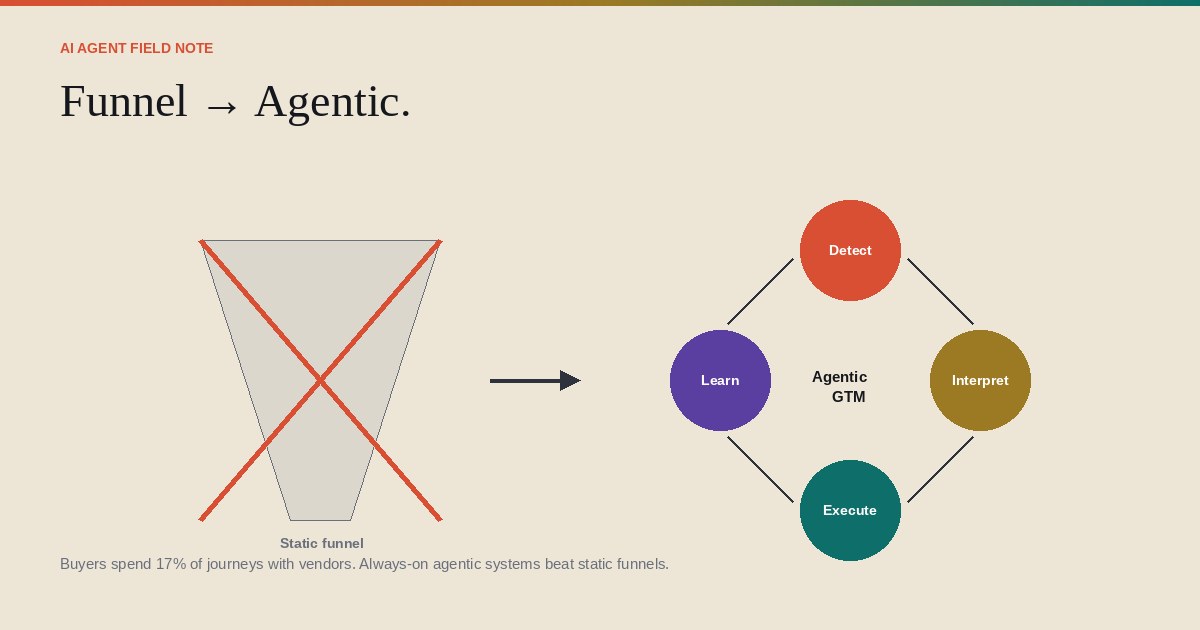
Static funnels were designed for a manual world. Agentic systems are designed for the one we live in.
This piece is a sector observation rather than an operator briefing — one of our occasional “from the field” reports on how the broader B2B GTM landscape is changing. Citations are public; the editorial frame is ours.
The funnel didn’t break. Buyers escaped it.
In 2011, Google published a study that quietly signaled the end of the traditional funnel. They found B2B buyers were nearly 60% through their decision before ever talking to sales. Today that number is even higher: according to Gartner, B2B buyers spend only 17% of their buying journey meeting with suppliers at all. The rest is spent researching independently, talking to peers, reading reviews, and evaluating options anonymously.
The funnel assumes you control the journey. You don’t anymore. Your buyers do. And increasingly, they’re interacting with machines before they ever interact with you.
Real buying journeys don’t look like funnels.
A real-world pattern from enterprise SaaS: a mid-market bank evaluating ERP modernisation might see a LinkedIn post and ignore it. Six months later, hire a Head of Finance Transformation. That person Googles ERP options. Visits your website three times in one week. Reads two blogs. Leaves. Searches again a month later. Asks peers in private Slack communities. Only then fills out a demo request.
No nurture sequence caused that. No funnel stage predicted it. Intent emerged gradually, across systems. The funnel didn’t create the opportunity — it simply observed it late.
Companies winning today run always-on systems.
Snowflake — scaling without relying on funnels
Snowflake didn’t grow through traditional MQL funnels. They built signal-driven GTM. Their system monitors product usage signals, account expansion patterns, role-based engagement, workload adoption signals. The result: rapid growth from $100M to $2B ARR while maintaining net revenue retention above 150%.
HubSpot — from inbound funnel to intent-driven GTM
HubSpot pioneered inbound marketing funnels. But internally, their model evolved. They now prioritise product-qualified leads (PQLs), behavioural signals and account engagement patterns — not form fills. A user actively using your product is infinitely more valuable than someone who downloaded an ebook.
Gong — identifying buyers before they raise their hand
Gong’s GTM team monitors hiring patterns. When a company hires a new VP of Sales, the probability of buying Gong increases significantly. So they engage early — before competitors even know the opportunity exists. This isn’t funnel execution. This is signal-driven execution.
The biggest shift: execution is becoming autonomous.
Traditional marketing automation executes predefined workflows. Agentic marketing executes adaptive workflows.
Traditional automation: wait for form fill, add to nurture sequence, send email every 7 days, assign lead score.
Agentic marketing: detect anonymous account visiting pricing page 3 times, cross-reference hiring signals, identify high-probability buying window, generate personalised outreach, trigger sales engagement immediately. No human required to initiate — only to guide strategy.
The funnel’s biggest flaw: static in a dynamic environment.
Funnels assume linear progression. Reality is probabilistic. At any given moment, only about 5% of your total addressable market is actively buying. Funnels waste enormous effort pushing uninterested buyers. Agentic systems focus only on those showing signals.
The companies that win won’t be those with the best funnels. They’ll be those with the best agentic GTM systems — because the fastest responder to intent will always outperform the best-planned nurture sequence.
What replaces the funnel: the Agentic GTM Engine.
The new model has four core components: signal detection (website visits, hiring activity, tech-stack changes, content engagement, product usage), intent interpretation (signal frequency, recency and combinations to determine likelihood of purchase), autonomous execution (personalised outreach, sales alerts, content targeting, account prioritisation triggered the moment intent crosses a threshold), and continuous learning (systems improve over time by learning which signals predict buying).
The practical impact: smaller teams, larger pipeline.
Companies adopting agentic GTM models are seeing measurable impact: higher pipeline per SDR, faster sales cycles, higher conversion rates, lower CAC. According to McKinsey, companies that effectively use AI in sales and marketing see 10–20% increase in sales productivity and 20% reduction in marketing costs.
What this means for your organisation.
The shift from funnel-led to agentic GTM is most urgent for organisations where:
- Sales cycles are long and timing-sensitive (enterprise SaaS, ERP, banking-tech)
- The buying committee is large and the relevant signal is fragmented across stakeholders
- Demand-gen teams are running hard but pipeline attribution is murky
- Competitors are already showing up earlier in buyer journeys than you are
The funnel was a useful abstraction. But it was never reality. It was a model designed for a manual execution world. The companies that adopt the agentic model early will operate faster, more efficiently and more effectively than those still relying on static funnels.
Where would an agentic GTM system reach into your funnel?
If you’re thinking about moving from a static funnel to an agentic, signal-driven GTM system — account detection, intent interpretation, autonomous execution, continuous learning — we’ll walk through which two or three pieces would move first for your team, and what it takes to make them compound. No deck, no pitch.
Get every field note in your inbox.
Industry-tailored briefings on AI agents, written for revenue leaders. One short note a week. No spam, unsubscribe in one click.
We’ll just ask for your name and company on the next step.