AI agents in 2026: 5 transformational use cases in B2B marketing.
- Funnels were designed for a manual world. AI agents change everything by autonomously identifying opportunities, engaging buyers and optimising campaigns.
- Five use cases driving the shift: autonomous account intelligence, hyper-personalised buying-group outreach, autonomous pipeline creation, continuous campaign optimisation, pipeline acceleration.
- Outcome: Higher pipeline per marketer, faster deal cycles, better sales-marketing alignment, improved ROI across all GTM activities.
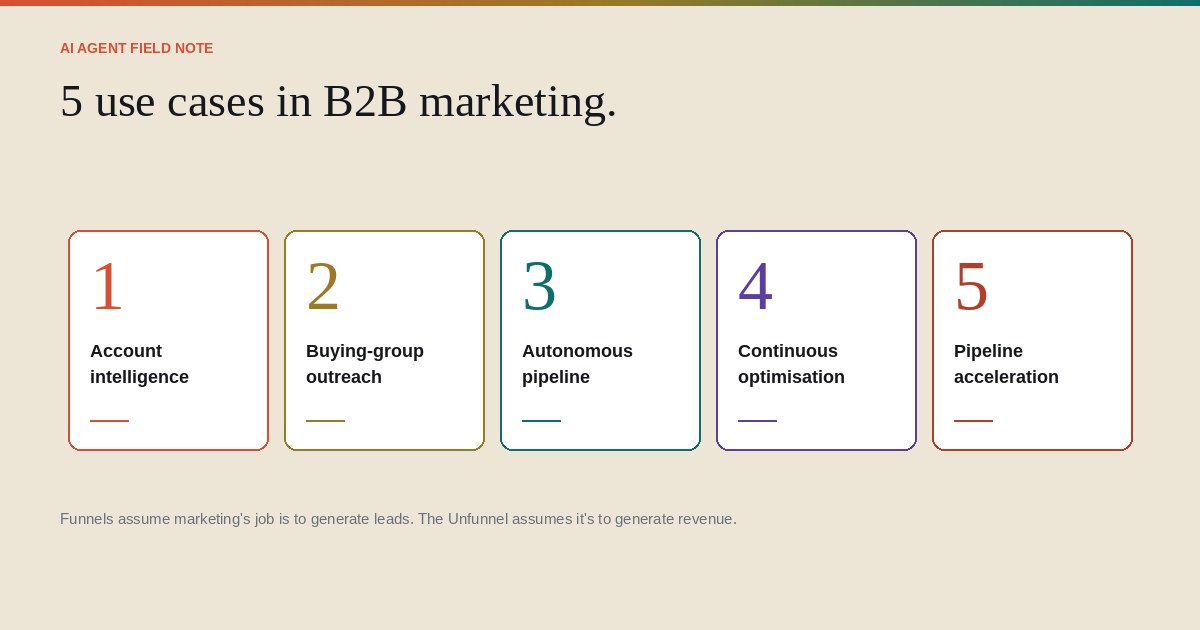
Five use cases driving the shift from funnel-led to agent-driven GTM.
This piece is a sector observation on the five highest-leverage AI agent use cases in B2B marketing today. For decades, B2B marketing has operated on a simple premise: fill the top of the funnel and hope enough leads convert. But funnels were designed for a manual world. Today’s reality is different — non-linear journeys, larger buying groups, fragmented intent signals, and speed as a competitive advantage. This is where AI agents change everything.
1. Autonomous account intelligence: from static lists to living targets.
Traditional approach: marketers build target account lists once or twice a year using static firmographic filters.
Agentic approach: AI agents continuously monitor your ICP accounts and identify real buying signals.
An AI agent monitoring enterprise banks detects a spike in hiring for “Digital Transformation” roles, new Salesforce-related job postings, and leadership discussing operational efficiency on earnings calls. The agent automatically flags the account as “high propensity,” generates a briefing document, and triggers personalised outreach campaigns. Instead of targeting accounts randomly, you focus only on accounts actively moving toward a buying decision.
2. Hyper-personalised outreach across entire buying groups.
In enterprise deals, there isn’t one buyer — there’s a buying committee. This typically includes economic buyers, technical evaluators, operational stakeholders, and executive sponsors. AI agents identify and engage each stakeholder with tailored messaging.
For a target bank: the CFO receives ROI-focused messaging, the Head of Operations receives efficiency and automation insights, IT leaders receive integration and architecture content. All automatically generated and delivered. The result: higher engagement rates, faster consensus building, reduced deal friction.
3. Autonomous pipeline creation (AI agents as digital BDRs).
Pipeline generation traditionally relies heavily on human SDRs doing manual prospecting. AI agents can now augment or perform this function autonomously: identify ideal accounts, discover relevant stakeholders, generate personalised outreach, follow up intelligently, route qualified opportunities to sales.
An AI agent identifies a bank expanding its commercial lending division. It automatically finds the Head of Commercial Lending, sends a personalised insight based on their expansion strategy, follows up based on engagement signals, and books a meeting when intent crosses a threshold. Pipeline is created continuously — not in bursts tied to campaigns or SDR capacity.
4. Continuous campaign optimisation without human intervention.
Traditional campaigns are launched, monitored, and optimised manually. AI agents optimise continuously. They test and refine messaging, personas, channels, timing, creative.
An AI agent detects that risk leaders engage more with compliance messaging, operations leaders engage more with automation messaging, LinkedIn performs better than email for certain personas. The agent automatically reallocates budget and adjusts messaging. Campaign performance improves continuously — without waiting for quarterly reviews.
5. Pipeline acceleration and deal velocity optimisation.
Winning deals requires consistent engagement throughout the buying journey. AI agents ensure no opportunity stalls. They monitor stakeholder engagement, buying signals, sales activity, account expansion opportunities.
An AI agent detects that engagement from technical stakeholders has dropped. It automatically sends relevant technical content, surfaces case studies, notifies sales with recommended actions. Deals move faster and close at higher rates.
Funnels assume marketing’s job is to generate leads. The Unfunnel assumes marketing’s job is to generate and accelerate revenue. AI agents don’t replace marketers — they give marketers leverage.
Why this changes the entire GTM model.
Instead of: Lead → MQL → SQL → Opportunity → Customer.
You get: Identify → Engage → Learn → Optimise → Expand → Repeat. Continuously. Autonomously. Intelligently.
The strategic shift: from campaigns to autonomous revenue engines.
Winning organisations are moving from:
- Campaign-centric GTM → Agent-driven GTM
- Lead generation → Opportunity generation
- Manual execution → Autonomous execution
- Funnels → Unfunnels
Organisations adopting agentic GTM models are seeing higher pipeline per marketer, faster deal cycles, better sales and marketing alignment, and improved ROI across all GTM activities. Most importantly, they shift from manual execution to autonomous growth systems — allowing teams to operate at a scale and precision that was previously impossible.
Where would AI agents land hardest in your GTM?
If you’re evaluating where to invest first — account intelligence, buying-group outreach, autonomous pipeline, campaign optimisation, or deal-velocity — we’ll walk through which two or three agents would move the needle for your B2B motion, what we’d build, and what your team would need to do to make it work. No deck, no pitch.
Get every field note in your inbox.
Industry-tailored briefings on AI agents, written for revenue leaders. One short note a week. No spam, unsubscribe in one click.
We’ll just ask for your name and company on the next step.