AI agents in 2026: 5 real-world use cases in healthcare.
- Healthcare is entering the age of autonomous systems. AI is no longer just analysing data — it’s taking action.
- Five high-impact use cases: clinical documentation (Nuance DAX, Abridge), care coordination (Memora Health), risk monitoring (Viz.ai), revenue cycle (AKASA), hospital operations (LeanTaaS).
- Outcome: Reduced clinician burnout, faster intervention, improved outcomes, scaled care delivery without scaling staff linearly.
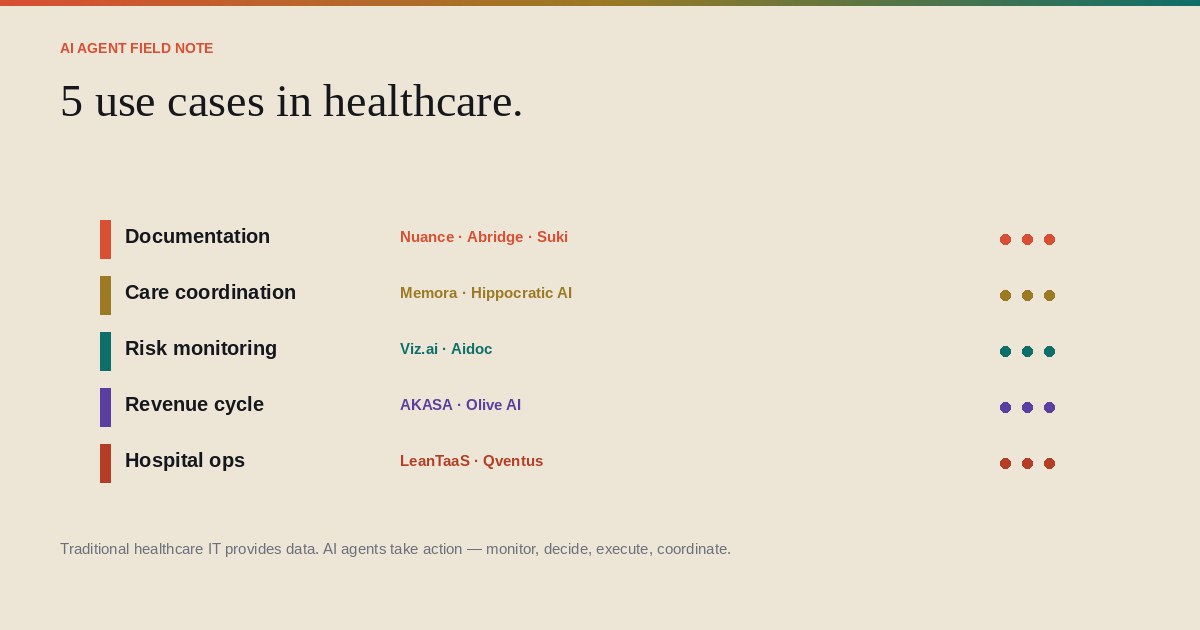
Five high-impact AI agent deployments inside healthcare today.
This piece is a sector observation on AI agents in healthcare. Healthcare is entering the age of autonomous systems. AI is no longer just analysing data — it is taking action. AI agents can monitor patients, coordinate care, automate workflows, and optimise hospital operations autonomously. Leading healthcare providers and technology companies are already deploying agentic AI to improve outcomes, reduce costs, and scale care delivery.
1. Autonomous clinical documentation.
Example companies: Nuance (Microsoft), Abridge, Suki.
Clinical documentation is one of the biggest drivers of clinician burnout. Doctors often spend more time documenting than treating patients. AI agents now act as autonomous medical scribes.
Nuance’s Dragon Ambient eXperience (DAX), used by organisations like Kaiser Permanente and Cleveland Clinic, listens to doctor-patient conversations and automatically generates clinical documentation. The AI agent captures the conversation, extracts clinical meaning, generates structured clinical notes, and updates the electronic health record. Doctors simply review and approve.
Impact: dramatically reduced documentation time, improved clinician satisfaction, increased patient face-time. Other companies in this space include Abridge (used by Mayo Clinic and UPMC) and Suki AI (used by major US health systems).
2. AI care coordination and patient engagement.
Example companies: Hippocratic AI, Care.ai, Memora Health.
AI agents are becoming autonomous care coordinators, supporting patients between visits.
Memora Health deploys AI agents that interact with patients via text and chat after procedures. The agent checks patient recovery status, asks structured clinical questions, identifies complications early, alerts clinicians when needed. This allows care teams to monitor thousands of patients simultaneously.
Impact: reduced readmissions, improved patient outcomes, reduced clinician workload. These agents provide scalable, proactive care coordination at a scale humans alone could never achieve.
3. Early detection and clinical risk monitoring.
Example companies: Aidoc, Viz.ai, Qventus.
AI agents continuously monitor patient data to identify life-threatening conditions earlier.
Viz.ai uses AI agents to monitor brain scans and detect strokes in real time. The agent analyses imaging data automatically, identifies stroke indicators, alerts specialists immediately, coordinates response workflows. This significantly reduces time to treatment.
Impact: faster intervention, improved survival rates, reduced disability. These AI agents act as always-on clinical monitoring systems.
4. Autonomous revenue cycle management.
Example companies: AKASA, Olive AI, Notable Health.
Healthcare loses billions annually due to inefficient billing and claim denials. AI agents are automating revenue cycle workflows end-to-end.
AKASA deploys AI agents that autonomously manage billing operations: review medical records, apply billing codes, submit claims, detect and resolve denials, follow up automatically. This eliminates massive amounts of manual administrative work.
Impact: faster reimbursement, increased revenue capture, reduced operational costs. These agents function as autonomous financial operators.
5. Hospital operations and capacity optimisation.
Example companies: Qventus, LeanTaaS, GE Healthcare.
Hospital operations involve complex coordination across beds, staff, equipment, and patient flow. AI agents can autonomously optimise these systems.
LeanTaaS uses AI agents to optimise operating room schedules, infusion centres, and hospital capacity. The agent predicts demand, optimises schedules, reduces bottlenecks, improves utilisation. Major health systems including Stanford Health Care and Johns Hopkins use LeanTaaS.
Impact: increased operating room utilisation, reduced patient wait times, improved hospital efficiency.
Traditional healthcare IT systems provide data. AI agents take action — they monitor continuously, make decisions autonomously, execute workflows, coordinate systems. This transforms healthcare from reactive to proactive.
Why this matters now.
Healthcare faces structural challenges: clinician shortages, rising patient demand, increasing administrative complexity, cost pressure. AI agents provide leverage. They allow healthcare systems to scale care delivery without scaling staff linearly.
The future: autonomous healthcare systems.
The most advanced healthcare organisations are moving toward agentic healthcare models, where AI agents handle documentation, patient engagement, monitoring, operations, and financial workflows. This allows clinicians to focus on what matters most: patient care.
Where would AI agents change your operating model?
If you’re evaluating agentic AI in healthcare — clinical documentation, care coordination, risk monitoring, revenue cycle, or hospital operations — we’ll walk through which two or three deployments would change outcomes fastest, and where the clinical-governance work sits. No deck, no pitch.
Get every field note in your inbox.
Industry-tailored briefings on AI agents, written for revenue leaders. One short note a week. No spam, unsubscribe in one click.
We’ll just ask for your name and company on the next step.