AI agents in 2026: 5 real-world use cases in transportation & logistics.
- Transportation and logistics are undergoing one of the most dramatic transformations in decades. AI agents are accelerating it.
- Five real-world use cases: route optimisation (UPS ORION saves $300–400M annually), supply chain control towers (DHL), autonomous warehouses (Amazon Robotics), predictive maintenance (FedEx), autonomous freight (Aurora, Uber Freight).
- Outcome: Companies that successfully adopt AI agents will gain significant advantages in speed, efficiency, and resilience.
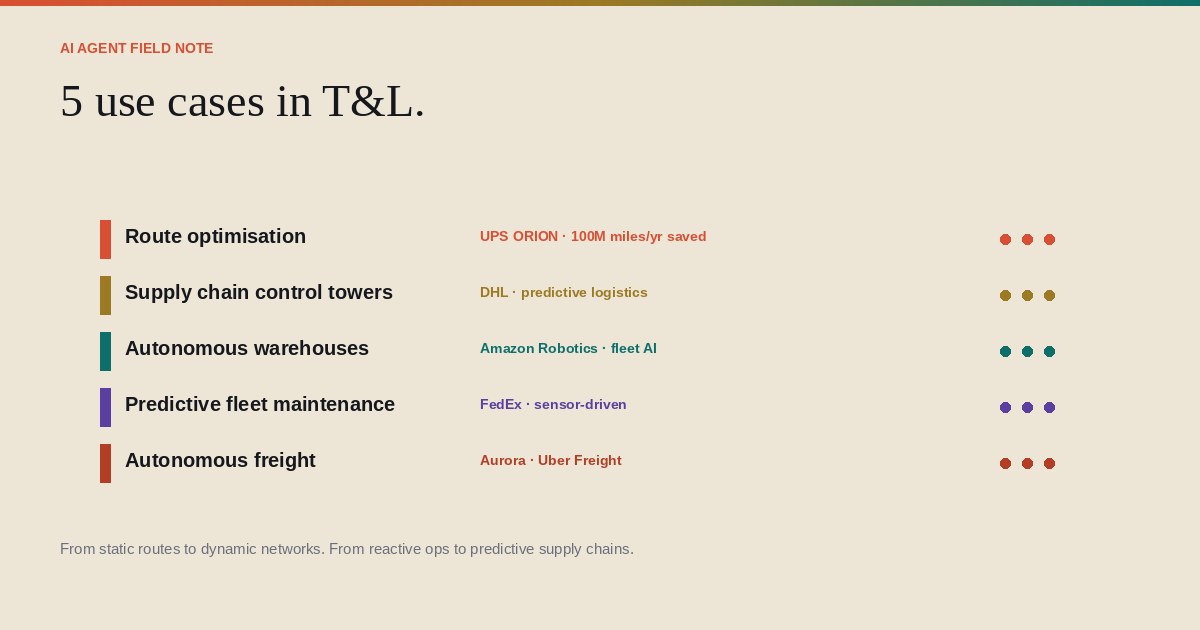
Five AI agent deployments transforming transportation and logistics.
This piece is a sector observation on AI agents in transportation and logistics. The industry is undergoing one of the most dramatic transformations in decades. Rising fuel costs, labour shortages, supply chain disruptions, and increasing customer expectations have pushed companies to rethink how operations are managed.
Unlike traditional automation or predictive analytics, AI agents can autonomously make decisions, coordinate systems, and execute tasks across complex logistics networks. By 2026, many transportation and logistics companies are deploying AI agents to improve efficiency, reduce costs, and increase supply chain resilience.
1. Autonomous route optimisation and dispatching.
Traditional routing software creates static plans at the beginning of the day. AI agents continuously analyse traffic patterns, weather conditions, vehicle capacity, delivery windows, fuel efficiency. Based on these inputs, AI agents can dynamically adjust routes and dispatch instructions to drivers throughout the day.
Example: UPS — ORION. UPS uses an AI-powered routing platform called ORION (On-Road Integrated Optimization and Navigation). The system analyses millions of route combinations daily and continuously improves delivery efficiency. Impact: 100 million miles saved annually, 10 million gallons of fuel reduced, $300–$400 million in cost savings per year.
AI agents allow logistics companies to operate dynamic delivery networks rather than static routes.
2. Intelligent supply chain control towers.
Modern logistics networks involve thousands of moving parts: warehouses, shipping carriers, customs checkpoints, ports, and distribution centres. AI agents are now powering supply chain control towers that monitor the entire network in real time.
These agents can detect disruptions, reroute shipments, predict delays, coordinate suppliers and carriers, trigger automated workflows.
Example: DHL. DHL uses AI-driven analytics and intelligent automation to monitor global shipments and proactively manage disruptions. The system can automatically identify delays at ports, recommend alternate shipping routes, notify customers about shipment status. AI agents shift logistics from reactive operations to predictive supply chain management.
3. Autonomous warehouse operations.
Warehouses are increasingly powered by fleets of robots and AI agents coordinating complex fulfilment operations. These AI agents manage inventory placement, picking and packing, robot coordination, order prioritisation, warehouse traffic flows. Rather than simple rule-based automation, AI agents dynamically optimise operations based on real-time demand.
Example: Amazon Robotics. Amazon operates one of the most advanced AI-powered logistics networks in the world. Inside Amazon fulfilment centres, robots transport shelves to workers, AI agents optimise picking routes, algorithms prioritise high-demand orders. This intelligent orchestration allows Amazon to deliver millions of packages daily while maintaining extremely fast fulfilment times.
4. Predictive maintenance for fleets.
Transportation companies operate massive fleets of trucks, planes, and ships. Unexpected equipment failures can cause major delays and expensive downtime. AI agents now monitor vehicle health using sensor data, engine performance metrics, historical maintenance records, environmental conditions. By analysing this data, AI agents can predict when parts are likely to fail and schedule maintenance proactively.
Example: FedEx. FedEx uses predictive analytics and AI-driven maintenance monitoring to reduce equipment failures across its global fleet. Benefits: fewer unexpected breakdowns, lower repair costs, improved delivery reliability.
5. Autonomous freight and self-driving logistics.
Perhaps the most transformative use case is autonomous freight transportation. AI agents are the core intelligence behind self-driving trucks and autonomous logistics systems. These agents analyse real-time sensor data, traffic conditions, and road environments to make driving decisions.
Example: Aurora and Uber Freight. Autonomous trucking companies like Aurora are developing AI-powered systems designed to operate long-haul freight routes without human drivers. In partnership with Uber Freight and major carriers, autonomous trucks are already being tested on highways in the United States. Potential benefits: 24/7 freight operations, lower labour costs, improved safety, faster shipping times.
The most successful logistics organisations won’t simply move goods. They’ll operate intelligent, self-optimising supply chains powered by AI agents.
The future: autonomous logistics networks.
Today’s AI deployments are just the beginning. The next generation of logistics platforms will likely consist of multiple collaborating AI agents managing entire supply chains, including transportation planning, warehouse coordination, carrier management, inventory forecasting, last-mile delivery. In this model, AI agents act as digital logistics managers, continuously optimising operations across the entire network.
Where would AI agents matter most in your network?
If you’re thinking about AI across route optimisation, supply chain control towers, autonomous warehousing, predictive maintenance, or autonomous freight — we’ll walk through which two or three deployments would compound across your network, and what it takes to run them. No deck, no pitch.
Get every field note in your inbox.
Industry-tailored briefings on AI agents, written for revenue leaders. One short note a week. No spam, unsubscribe in one click.
We’ll just ask for your name and company on the next step.