AI agents in 2026: 5 real-world use cases in fashion.
- Fashion is undergoing massive digital transformation. From predicting trends to managing supply chains, AI agents are driving smarter decisions and faster operations.
- Five real-world use cases: AI stylists (Stitch Fix), trend forecasting (Zara), demand forecasting (H&M), supply chain optimisation (Nike), virtual try-on (Gucci, Snapchat).
- Outcome: Reduced overproduction and returns, faster trend response, hyper-personalised shopping experiences at scale.
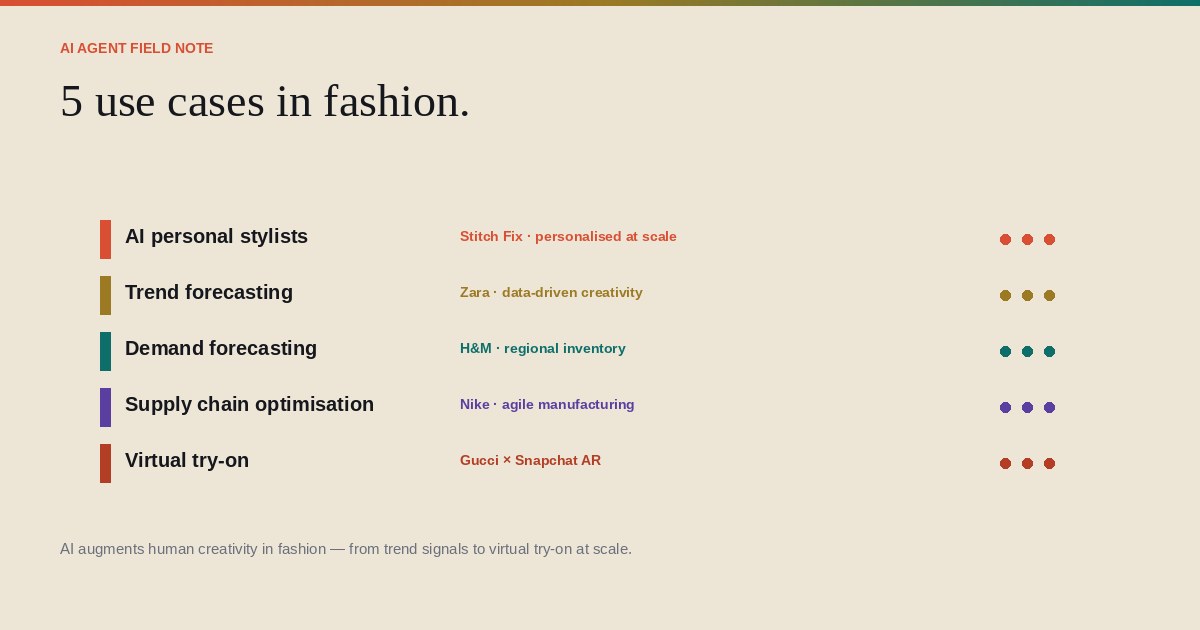
Five AI agent deployments reshaping fashion brands today.
This piece is a sector observation on AI agents in fashion. The industry is undergoing massive digital transformation. From predicting trends to managing global supply chains and personalising shopping experiences, brands are turning to AI agents to drive smarter decisions and faster operations. By 2026, AI agents are helping fashion brands streamline operations, reduce waste, and create hyper-personalised customer experiences.
1. AI personal stylists and shopping assistants.
One of the most visible uses of AI agents in fashion is personalised shopping assistants. These AI agents analyse browsing behaviour, purchase history, style preferences, body measurements, seasonal trends. Based on this information, they can recommend outfits, suggest complementary items, and even build entire wardrobes.
Example: Stitch Fix. Fashion retailer Stitch Fix uses AI-powered recommendation systems combined with human stylists to create personalised clothing selections for customers. The system analyses millions of data points including customer feedback, return patterns, style preferences. This allows Stitch Fix to deliver highly personalised clothing boxes tailored to each shopper.
AI agents help brands deliver highly personalised shopping experiences at scale, increasing customer satisfaction and sales.
2. AI trend forecasting and fashion design.
Fashion trends evolve rapidly, making forecasting a major challenge. AI agents can analyse massive datasets including social media trends, runway shows, influencer content, global purchasing patterns, cultural signals. These systems help designers predict emerging trends and design collections accordingly.
Example: Zara (Inditex). Fashion giant Zara uses data analytics and AI systems to monitor customer behaviour and detect emerging trends. Store data and online shopping patterns help designers quickly adjust collections and produce new styles within weeks. AI agents enable data-driven creativity, helping brands stay ahead of fast-changing consumer tastes.
3. Intelligent inventory and demand forecasting.
Fashion retailers often struggle with overproduction and unsold inventory. AI agents are helping solve this through advanced demand forecasting. These systems analyse historical sales data, seasonal patterns, regional demand, marketing campaigns, external factors like weather. AI agents can automatically recommend production levels, adjust inventory distribution, and trigger restocking decisions.
Example: H&M. Global retailer H&M uses AI-driven demand forecasting to optimise inventory across its stores and online channels. The system predicts which products will sell in specific regions, allowing stores to stock the right items at the right time. AI agents reduce overproduction, stockouts, and markdown losses — major challenges in the fashion industry.
4. Smart supply chain and production optimisation.
Fashion supply chains are complex and global, often involving multiple factories, suppliers, and distribution centres. AI agents can manage and optimise these networks by monitoring supplier performance, identifying delays, recommending alternative sourcing options, optimising shipping routes, predicting production bottlenecks.
Example: Nike. Sportswear giant Nike uses AI and advanced analytics to optimise manufacturing and supply chain planning. These systems help Nike adjust production quickly based on real-time demand signals and market trends. AI agents create more agile supply chains, enabling brands to respond faster to market demand.
5. Virtual try-on and AI-powered shopping experiences.
Online fashion shopping often suffers from a major problem: customers can’t try on clothes before purchasing. AI agents are solving this through virtual try-on technology and augmented reality shopping experiences. These systems use computer vision and AI to simulate how clothing will look on a customer’s body.
Example: Gucci and Snapchat. Luxury brand Gucci partnered with Snapchat to create AR-powered virtual try-on experiences for shoes and accessories. Customers can see how items look on them using their smartphone camera before making a purchase. AI-powered try-on experiences reduce returns while increasing buyer confidence and engagement.
AI agents won’t replace designers or stylists — but they will augment human creativity and help fashion brands operate at unprecedented speed and scale.
The future: autonomous fashion ecosystems.
The future of fashion will likely involve entire AI-driven ecosystems coordinating design, production, marketing, and retail operations. In this model, AI agents could manage end-to-end processes such as trend detection, collection design, manufacturing planning, inventory distribution, personalised marketing. Instead of disconnected systems, fashion brands will operate intelligent, self-optimising platforms powered by AI agents.
Where would AI agents matter most for your brand?
If you’re looking at AI in fashion — personal stylists, trend forecasting, inventory, supply chain, or virtual try-on — we’ll walk through which two or three deployments would compound for your brand, and what your team would need to do to run them. No deck, no pitch.
Get every field note in your inbox.
Industry-tailored briefings on AI agents, written for revenue leaders. One short note a week. No spam, unsubscribe in one click.
We’ll just ask for your name and company on the next step.