AI agents in 2026: 5 real-world use cases in consumer goods.
- Consumer goods is evolving rapidly. Changing expectations, supply chain volatility and intense competition are forcing companies to become more agile.
- Five real-world use cases: demand forecasting (P&G), shelf monitoring (Unilever), personalised marketing (Coca-Cola), supply chain (Nestlé), product innovation (PepsiCo).
- Outcome: Reduced waste, more resilient supply chains, faster product innovation cycles, hyper-personalised customer experiences.
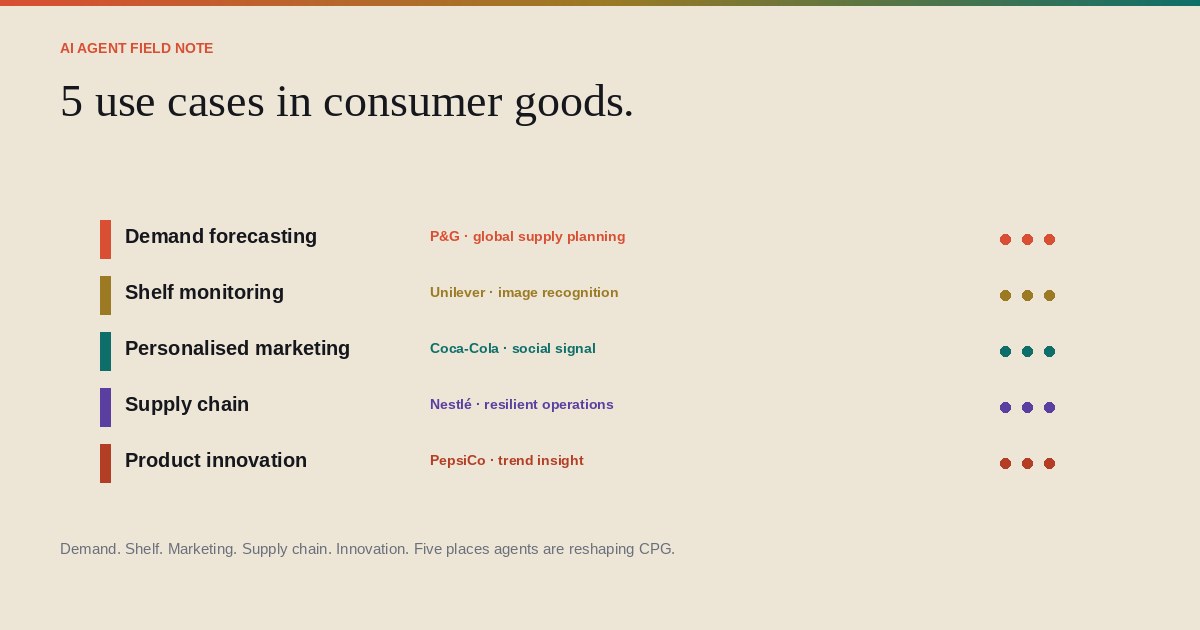
Five AI agent deployments transforming consumer goods today.
This piece is a sector observation on AI agents in consumer goods. The industry is evolving rapidly. Changing consumer expectations, supply chain volatility, and intense competition are forcing companies to become more agile, data-driven, and efficient. In response, many organisations are adopting AI agents — autonomous systems that can analyse data, make decisions, and take action across multiple business processes.
1. AI-powered demand forecasting and inventory planning.
One of the biggest challenges in consumer goods is accurately predicting demand. Overproduction leads to excess inventory and markdowns, while underproduction results in lost sales. AI agents help solve this problem by analysing large datasets including historical sales data, seasonal patterns, promotional campaigns, weather data, regional buying behaviour. These agents can continuously update demand forecasts and automatically recommend production and distribution adjustments.
Example: Procter & Gamble. P&G uses AI and advanced analytics to improve demand forecasting and supply planning across its global brands. By analysing retail sales data and market signals, P&G can better predict product demand and optimise inventory across different regions. AI agents help consumer goods companies reduce waste, improve product availability, and optimise production planning.
2. Intelligent retail shelf monitoring.
Retail execution is critical in the consumer goods industry. Products that are out of stock or poorly displayed can lead to lost revenue. AI agents are increasingly used to monitor retail shelves using computer vision, mobile scanning apps, in-store cameras. These systems can automatically detect out-of-stock products, incorrect pricing, poor shelf placement, competitor activity.
Example: Unilever. Unilever uses AI-powered image recognition tools that allow field representatives to scan store shelves using smartphones. The system instantly analyses shelf conditions and recommends actions to improve product visibility and availability. AI agents help ensure that products are available and properly displayed, improving retail performance.
3. Personalised marketing and customer engagement.
Consumer goods companies traditionally relied on broad marketing campaigns. AI agents now enable hyper-personalised marketing strategies based on individual customer behaviour. These agents analyse purchase history, loyalty programme data, browsing behaviour, demographic insights, real-time engagement data. Based on this, AI agents can automatically deliver personalised offers, product recommendations, and promotions.
Example: Coca-Cola. Coca-Cola uses AI-driven analytics to personalise marketing campaigns and better understand consumer preferences. The company analyses social media and consumer data to tailor messaging and product promotions for different markets. AI agents enable brands to deliver more relevant marketing experiences that increase customer engagement and loyalty.
4. Autonomous supply chain optimisation.
Consumer goods supply chains involve complex global networks of suppliers, manufacturers, warehouses, and retailers. AI agents can monitor and optimise these networks in real time by predicting supply disruptions, optimising transportation routes, adjusting production schedules, recommending alternative suppliers, managing warehouse inventory.
Example: Nestlé. Nestlé uses AI and advanced analytics to optimise its global supply chain operations. These systems help the company anticipate demand changes, adjust manufacturing output, and improve distribution efficiency. AI agents create more resilient and adaptive supply chains, reducing operational risks and costs.
5. AI-driven product innovation and development.
Innovation is essential in the consumer goods industry. Companies must constantly introduce new products that match changing consumer tastes. AI agents can analyse massive datasets including consumer reviews, market research, social media trends, ingredient preferences, emerging lifestyle trends. These insights help companies identify opportunities for new product development.
Example: PepsiCo. PepsiCo has used AI tools to analyse consumer data and identify emerging flavour trends. These insights helped inspire new snack and beverage products tailored to evolving consumer preferences. AI agents accelerate product innovation cycles, enabling brands to bring new products to market faster.
The most successful consumer goods brands won’t just sell products. They’ll run intelligent, AI-powered businesses capable of adapting to market changes in real time.
The future: autonomous consumer goods operations.
The next evolution of AI in consumer goods will involve connected ecosystems of AI agents managing end-to-end operations. These agents could coordinate processes such as demand forecasting, product development, manufacturing planning, supply chain management, retail execution, personalised marketing. Instead of disconnected tools, companies will deploy AI-powered operational platforms that continuously optimise the entire value chain.
Where would AI agents reshape your CPG operation?
If you’re evaluating AI agents across demand forecasting, shelf monitoring, personalised marketing, supply chain or product innovation — we’ll walk through which two or three deployments would move your numbers fastest, and what it would take to run them. No deck, no pitch.
Get every field note in your inbox.
Industry-tailored briefings on AI agents, written for revenue leaders. One short note a week. No spam, unsubscribe in one click.
We’ll just ask for your name and company on the next step.