AI agents in 2026: 5 real-world use cases in banking.
- AI has been used in banking for years — but 2026 marks the rise of AI agents that can reason, take action and orchestrate complex workflows.
- Five real-world use cases: financial assistants (Bank of America Erica, 2B+ interactions), fraud detection (Capital One), automated loan underwriting, contract intelligence (JPMorgan COiN, 360,000 hours saved annually), digital workers (Goldman Sachs, BNY Mellon).
- Outcome: Banks that deploy agentic AI effectively will build AI-powered operating models for the future of banking.
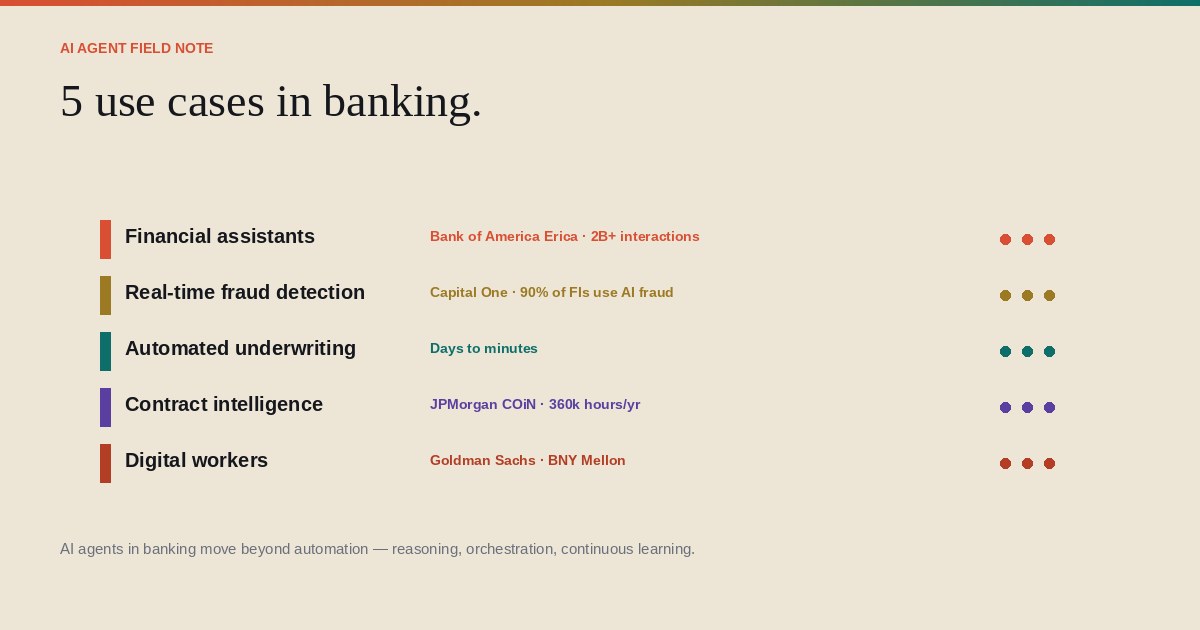
Five real-world AI agent deployments transforming banking.
This piece is a sector observation on AI agents in banking. Artificial intelligence has been used in banking for years, but 2026 marks the rise of AI agents — autonomous systems that can reason, take action across systems, and collaborate with humans to complete complex workflows. Unlike traditional automation or static chatbots, AI agents can interpret goals, orchestrate multiple tasks, and continuously learn from outcomes.
Major banks are already deploying hundreds of AI-driven use cases across customer service, fraud detection, underwriting, and operations. Below are five real-world AI agent use cases transforming banking in 2026.
1. AI financial assistants for customers.
One of the most visible applications is customer-facing financial assistants embedded in mobile banking apps. These agents can answer customer questions, provide spending insights, execute payments or transfers, and detect unusual activity. Unlike simple chatbots, modern AI assistants connect directly to core banking systems.
Example: Bank of America’s Erica. Bank of America’s AI assistant Erica is one of the most successful banking AI deployments. Over 2 billion customer interactions, used by 42 million clients. The assistant proactively alerts customers about unusual spending patterns and opportunities to save.
AI agents reduce support costs while providing 24/7 personalised financial assistance at scale.
2. Real-time fraud detection and prevention.
Fraud is becoming more sophisticated, especially with criminals using AI-generated identities and deepfakes. To combat this, banks are deploying AI agents that monitor transactions in real time. These agents analyse millions of transactions, detect suspicious patterns, trigger alerts or block transactions, and initiate investigations automatically. AI-powered fraud systems continuously learn from new attack patterns.
Industry data suggests 90% of financial institutions now use AI in fraud detection or investigation workflows.
Example: Capital One. Capital One uses machine learning and AI to detect suspicious transactions instantly, protecting customers while minimising false positives. AI agents enable real-time risk decisions, reducing financial losses and improving customer trust.
3. Automated loan underwriting and credit decisions.
Loan underwriting is traditionally slow, requiring manual review of financial documents, credit history, and risk models. AI agents now assist by collecting borrower data from multiple systems, analysing financial behaviour and creditworthiness, generating underwriting recommendations, flagging risk factors for human review.
Many banks now use AI-driven credit engines to automate loan decisioning, reducing approval times from days to minutes. These systems analyse income data, spending patterns, historical credit behaviour. AI agents make lending faster, more scalable, and more consistent — especially for digital-first banking experiences.
4. Intelligent document and contract processing.
Banks process massive volumes of contracts, regulatory filings, and loan documentation. AI agents can extract key clauses, identify compliance risks, summarise contracts, trigger workflows for approvals.
Example: JPMorgan’s COiN platform. JPMorgan’s COiN (Contract Intelligence) system reviews commercial agreements using AI. The result: 360,000 hours of manual legal work saved annually, 80% reduction in document review errors. Instead of lawyers manually reviewing documents, AI agents analyse them instantly and escalate exceptions.
5. AI agents for internal operations — digital workers.
The newest evolution in banking AI is the rise of AI agents acting as digital employees. These agents can research policies and compliance rules, generate reports, assist analysts with financial data, support employees during client interactions. Some banks even assign these agents corporate logins and defined job roles.
Example: Goldman Sachs and BNY Mellon. Goldman Sachs is developing AI agents with Anthropic to automate internal banking tasks such as due diligence and transaction accounting. BNY Mellon has deployed AI “digital workers” performing tasks like coding and payment validation. AI agents augment human employees, improving productivity and freeing teams to focus on high-value work.
The competitive advantage will increasingly depend on how effectively banks deploy agentic AI across their organisation. Institutions that succeed won’t just automate tasks — they’ll build AI-powered operating models for the future of banking.
The future: agentic banking platforms.
The next phase of AI in banking will likely move beyond individual use cases toward fully agentic banking platforms. These systems will coordinate multiple specialised AI agents to manage end-to-end workflows such as customer onboarding and KYC, credit underwriting, fraud investigation, compliance monitoring, treasury management. Instead of isolated tools, banks will deploy AI-driven operational layers that orchestrate entire financial processes.
Where could AI agents compound for your bank?
If you’re thinking about agentic AI in banking — financial assistants, fraud detection, automated underwriting, contract intelligence, or digital workers — we’ll walk through which two or three deployments would compound the most for your operating model, and where the institutional risk lies. No deck, no pitch.
Get every field note in your inbox.
Industry-tailored briefings on AI agents, written for revenue leaders. One short note a week. No spam, unsubscribe in one click.
We’ll just ask for your name and company on the next step.